Pulse24 Original
Mercedes Priced Kimi Antonelli Like a Rookie. Formula 1 May Not Let That Last.
August 1, 2026
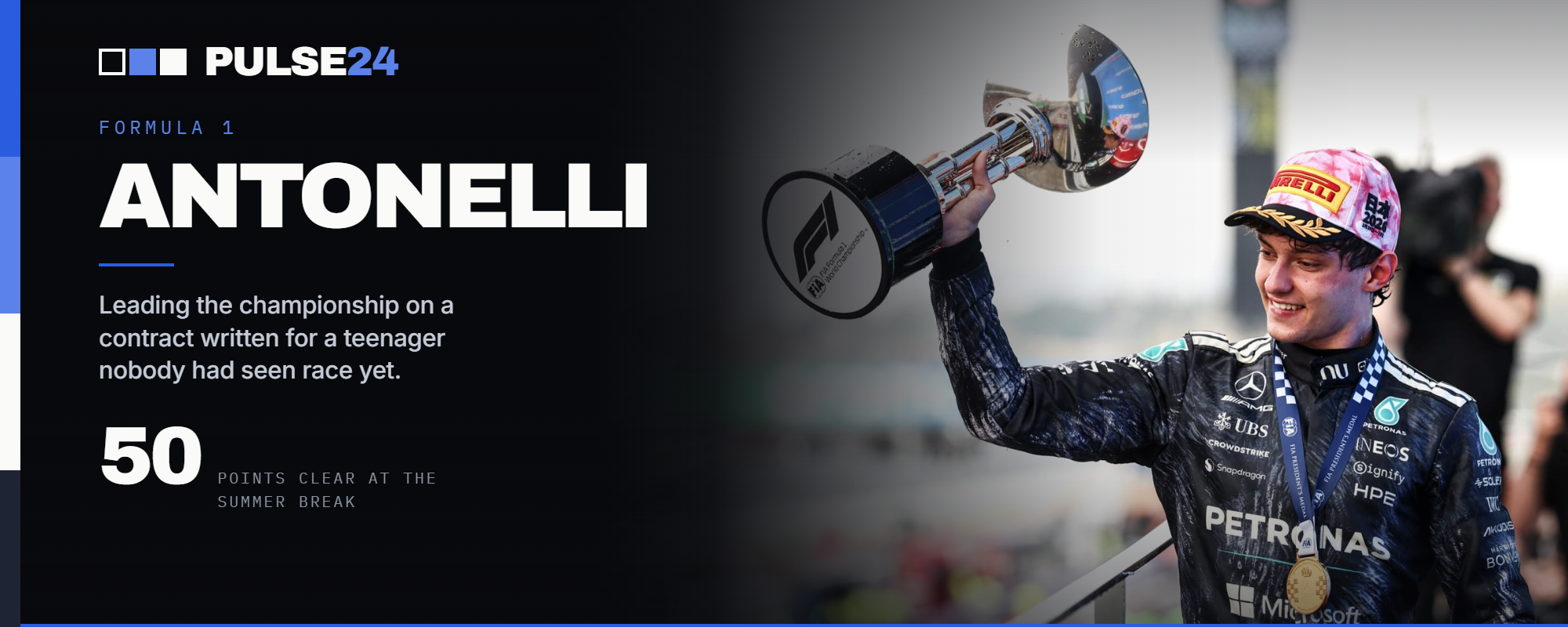
Kimi Antonelli leads the 2026 F1 championship by 50 points on a contract still priced for a rookie. This is how F1 actually prices young drivers, and why a season like his is exactly what breaks that pricing.
Kimi Antonelli's Mercedes contract reportedly pays him a $2 million base salary this year. George Russell, the teammate he has beaten by 59 points through eleven rounds, earns $34 million, according to RacingNews365. That gap, roughly seventeen times on those figures, is not a scandal or a mistake. It is what a rookie contract is designed to do: pay for potential rather than results, because nobody really knows in advance whether an 18 year old Formula 2 graduate will become a championship-calibre driver. Antonelli has now spent a season and a half answering that question, and the answer has arrived faster and more emphatically than the number attached to his name.
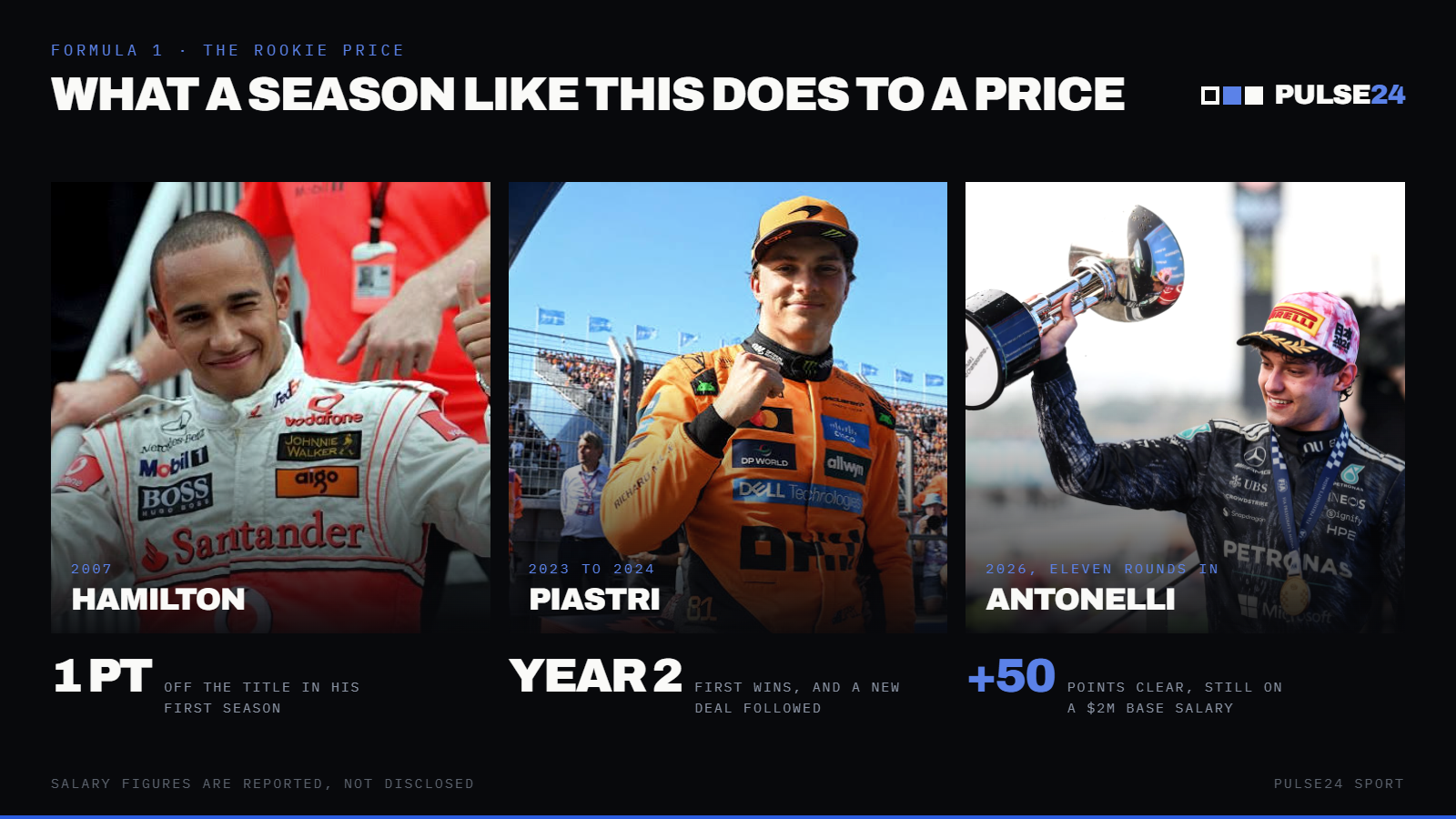
F1 contracts are not public documents. Teams treat salary figures the way most companies treat them, as leverage, not disclosure, so every number in this piece carries the caveat that it comes from salary trackers and reporting rather than a released term sheet. But the pattern those trackers describe, and the pattern this season is now testing in real time, is consistent enough to explain something bigger than one driver's paycheck: how F1 actually prices young talent, and what happens when the pricing turns out to be wrong.
The Pick Mercedes Won't Call a Backup Plan
Lewis Hamilton announced his move to Ferrari in February 2024, and Toto Wolff has said he made up his mind about a replacement within five minutes of hearing the news. What came next complicates the tidy version of that story. Mercedes looked seriously at whether Verstappen could be pulled out of a Red Bull deal that ran through 2028, an approach Wolff later acknowledged rather than denied. Only once that path proved unrealistic did Mercedes confirm Antonelli, on August 31, 2024, the day after he crashed out of his own FP1 debut at Monza and then went and qualified sixth in Formula 2 later that same afternoon.
None of that makes Antonelli a bad choice. He had already won Italian and ADAC F4 titles and the Formula Regional European Championship before skipping F3 entirely to jump into F2, the kind of fast-tracked résumé Mercedes builds its junior program around. But the sequence, chase the proven star first, sign the prospect once the star isn't available, is exactly why the market treated him as insurance rather than a marquee signing. Insurance policies aren't supposed to lead the championship a season later, and that's precisely the position he's in now. Pulse24 has covered how that read of Antonelli held up through his rookie year and into a 50-point lead heading into F1's summer break. What this piece is interested in is what a read like that does to a driver's price, and how quickly that price moves once the read turns out to be wrong.
What a Rookie Contract Is Actually Built to Pay
F1 rookie deals follow a fairly consistent shape across the grid. Two year terms with the team holding a third year option. Base salaries in the low to mid seven figures, conservative because nobody wants to overpay for an unproven quantity. And bonus structures that do the real work, worth $40,000 to $75,000 per championship point on top of smaller payments for top ten finishes, according to F1Salaries. A driver who is merely solid barely notices those bonuses. A driver who wins races sees them compound fast.
Antonelli's own package sits at the modest end of that structure on paper. Reports on his total compensation vary widely, with some trackers putting his full 2026 package including bonuses somewhere between $9 million and $13 million. The estimates vary enough that nobody outside Mercedes and his own camp really knows the final number. What is better sourced is the base salary trackers largely agree on: $2 million, the same tier reserved for other promising but unproven names on the grid, and a fraction of what a driver leading the championship earns everywhere else in the sport.
The Grid Has Repriced Rookies Before
This isn't a new phenomenon. Repricing rookies is closer to the standard playbook across the grid, just rarely watched this closely in real time. Isack Hadjar spent 2025 at Racing Bulls on a salary reportedly under $1 million. One strong season later, his promotion to Red Bull alongside Verstappen came with a package worth roughly $7 million, close to five times his previous pay, because a year of race results did what no amount of junior category form could.
Lando Norris is the longer arc of the same idea. McLaren signed him for roughly $260,000 in 2019. By 2021 that had grown to around $9 million as his pace became undeniable. A four year deal in 2022 pushed him past $20 million, and his current contract for 2026 and 2027 reportedly pays a $25 million base with up to $10 million more in bonuses, according to SalaryLeaks. None of that happened because Norris renegotiated harder. It happened because the results made the old number impossible to defend.
Why Antonelli's Case Breaks the Usual Pattern
Both of those repricings happened after a season closed, once a full body of results existed to argue with. Antonelli's is unfolding mid-contract, mid-championship, with his side already leading by 50 points at the summer break and no confirmed deal covering 2027. He has been careful about how he talks about it. "Especially, with all the ups and downs in the difficult period, some doubt starts to kick in," he said of the uncertainty. Asked about security beyond this year, his answer was blunter still: "I need to perform, and I need to deliver the results."
That framing matters more than it sounds like it should, because it means his next negotiation is likely to open this winter while he is still the reigning points leader, not after the season has settled into a verdict. Every other driver on this list renegotiated from hindsight. Antonelli, if the lead holds, would be negotiating from inside the story itself, and every agent representing a promising young driver elsewhere on the grid will be watching exactly how Mercedes prices that.
A title contender on a rookie-tier base salary is not a stable equilibrium.
Somebody moves. Either Mercedes tears up the number early to keep the leverage of loyalty, or Antonelli's camp lets the season finish and negotiates from a full championship résumé instead of half of one.
History offers a caution against assuming any of this is settled. Antonelli's points lead once compared almost exactly to Fernando Alonso's 42-point advantage over Sebastian Vettel at the same stage of 2012, a gap Vettel closed entirely and turned into a three-point title win. Contract repricing follows results, and results in this sport have a way of not cooperating with the story everyone is ready to write in July.
What to Watch Next
F1 returns from its summer break at the Dutch Grand Prix in Zandvoort on August 21 to 23, a sprint weekend and, per F1's own confirmation, the race's final edition on the calendar. The racing will decide whether Antonelli's lead survives contact with a car that has to defend it for twelve more rounds. The more interesting number won't be on the timing screens, though. It will be in the first credible report of Antonelli's next contract: whether Mercedes moves early, while it can still call the discount loyalty, or waits, the way most teams do, until the results make the old number impossible to defend.
The Pulse24 Take
F1's contract market is built to be conservative about unproven drivers and generous, eventually, toward proven ones. That system works fine when the gap between those two states closes gradually, over a season or two of steadily improving results. It works less predictably when a driver closes that gap in a single year while sitting on top of the championship table. The negotiation stops being just about what Antonelli is worth and becomes a question of whether Mercedes wants to be the team that waited for hindsight, or the one that paid early for a story that was still being written. Every rookie contract is a bet on who a driver might become. Antonelli's season suggests Mercedes may have already won that bet. The market has already repriced Antonelli. His contract hasn't caught up yet.
How we read the data
Curious how we get from raw data to a take like this? Our Trader's Toolkit walks through the tools we lean on.
Explore the Toolkit