Pulse24 Original
Britain's 30-Year Bond Yield Hit 6% for the First Time Since 1998. The Budget That Could Calm It Is Three Weeks Away.
October 9, 2026
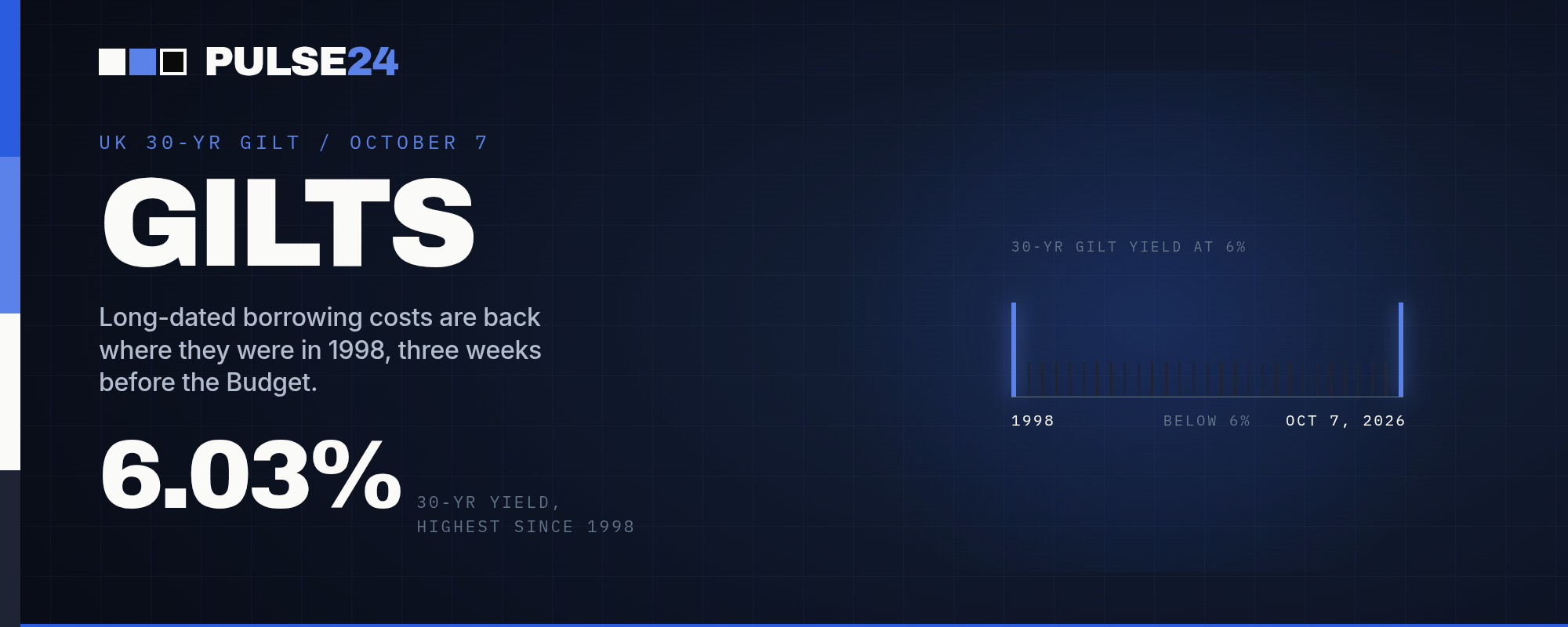
Britain's 30-year borrowing cost touched its highest level since 1998 this month, and bond markets are waiting to see whether Chancellor Healey's October 28 Budget restores confidence or repeats the mechanics of the 2022 mini-budget crisis.
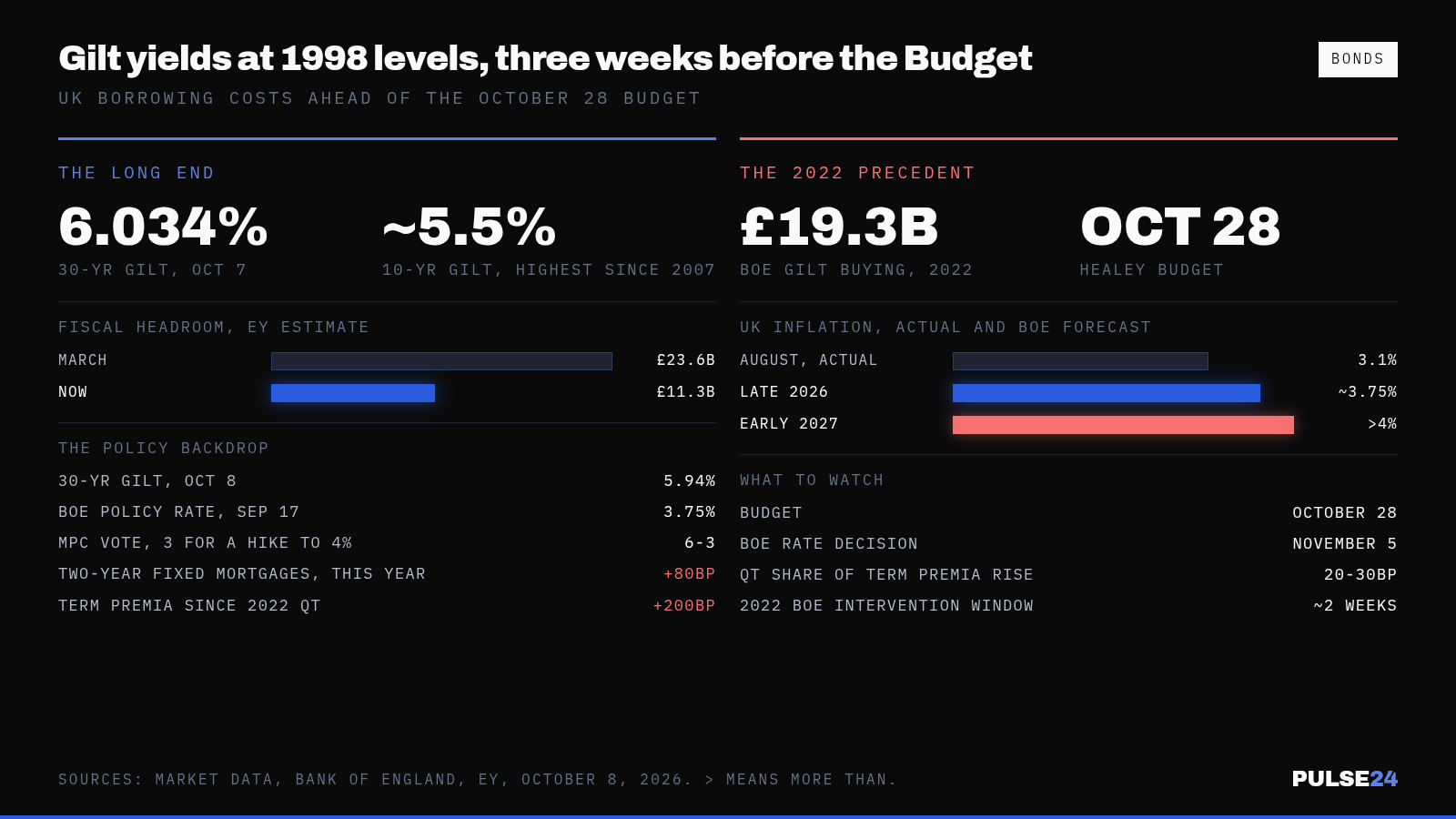
Britain's 30-year government bond touched a yield of 6.034% on October 7, the highest reading since 1998. The move capped a month in which the long end of the UK curve broke above 6% for the first time in almost three decades, pulling the 10-year gilt yield up to roughly 5.5% along with it, a level unseen since 2007.
What Changed
Yields eased slightly by October 8, with the 30-year gilt settling near 5.94%, but the direction of travel has been clear for months. The sell-off reflects a mix of forces: a broader global rise in long-term borrowing costs, persistent inflation running at 3.1% in August, and mounting doubt about whether the government's finances add up heading into Chancellor John Healey's first Budget on October 28.
The Bank of England held its policy rate at 3.75% on September 17, but the vote split 6-3, with three committee members pushing for a hike to 4%. Its own forecasts put inflation near 3.75% by late this year and slightly above 4% in early 2027, hardly the backdrop that makes a government's spending commitments look comfortable.
Andrew Bailey weighed in directly, telling a conference in Istanbul that fiscal policy 'must be credible and directed at stability, and to be seen to be such by markets,' adding that credible plans to bring down debt matter more, not less, when the economy absorbs repeated shocks. He was careful to frame it as an observation rather than policy advice, central bankers rarely get to pick their words so bluntly in public, but the timing left little doubt who the message was for.
Why It Matters
Fiscal headroom, the buffer between what the government plans to spend and what its own rules allow, has been shrinking fast. EY now estimates Healey's headroom has fallen to about 11.3 billion pounds, down from 23.6 billion in March, largely because higher borrowing costs mean more of the budget goes toward servicing existing debt. Every basis point the 30-year yield adds makes the math a little tighter.
The mortgage market is already feeling it. Two-year fixed rates have climbed roughly 80 basis points this year, per Bank of England financial stability reporting, as gilt yields marched higher, a direct line from government bond markets to household budgets that often gets lost in the back-and-forth over tax rates. UK bank shares also fell sharply on October 1 amid speculation that the Budget could include a new tax on bank profits, with Barclays, HSBC, and Lloyds executives reportedly summoned to meet with Treasury officials.
None of this guarantees a repeat of 2022, when Liz Truss's mini-budget triggered a collateral-call spiral among pension funds using leveraged liability-driven investment strategies, forcing the Bank of England to step in and buy 19.3 billion pounds of gilts over about two weeks to restore order. But the comparison is doing a lot of work in markets right now, precisely because the mechanics that made 2022 so violent, leveraged pension positioning sensitive to sudden yield moves, haven't disappeared. Term premia on UK debt have risen roughly 200 basis points since the Bank's quantitative tightening program began in 2022, and the Bank itself attributes 20 to 30 basis points of that to its own bond sales.
What to Watch Next
Britain isn't an isolated case. The same global repricing pushed Japan's benchmark bond yield to a level unseen since 1996 this week, and investors have spent much of this year punishing French bonds over similar doubts about fiscal credibility, widening the spread between French and German debt even as eurozone inflation ran hot. Developed-market governments are discovering, in sequence, that bond markets no longer take fiscal promises on faith.
The next two checkpoints are specific. Healey's Budget on October 28 will show whether the numbers hold together without new borrowing surprises, and the Bank of England's next rate decision on November 5 will show how much the committee's hawks have been emboldened by inflation that keeps running above target. A Budget that markets read as credible could pull yields back toward where they started the year. One that doesn't could test whether the LDI sector's post-2022 safeguards actually hold under pressure.
The Pulse24 Take
There's a useful distinction between a bond market that's nervous and one that's in crisis, and Britain right now sits closer to the first. Yields at 1998 levels sound alarming next to a chart, but they also reflect a genuinely higher-rate world across every major economy, not just a UK-specific panic. A Budget that fails to show a credible path on debt would change that calculus fast, and the mortgage-rate pain already visible in the data would spread faster than most households are prepared for. Watching the gilt market over the next three weeks comes down to one question: can the government still convince professional bond buyers that its arithmetic works? That's a lower bar than people often assume, and one Britain hasn't always cleared easily in recent years.
How we read the data
Curious how we get from raw data to a take like this? Our Trader's Toolkit walks through the tools we lean on.
Explore the Toolkit