Pulse24 Original
SpaceX Paid $8 Billion for Spectrum. It Erased $39 Billion From Telecom Stocks in a Day.
October 11, 2026
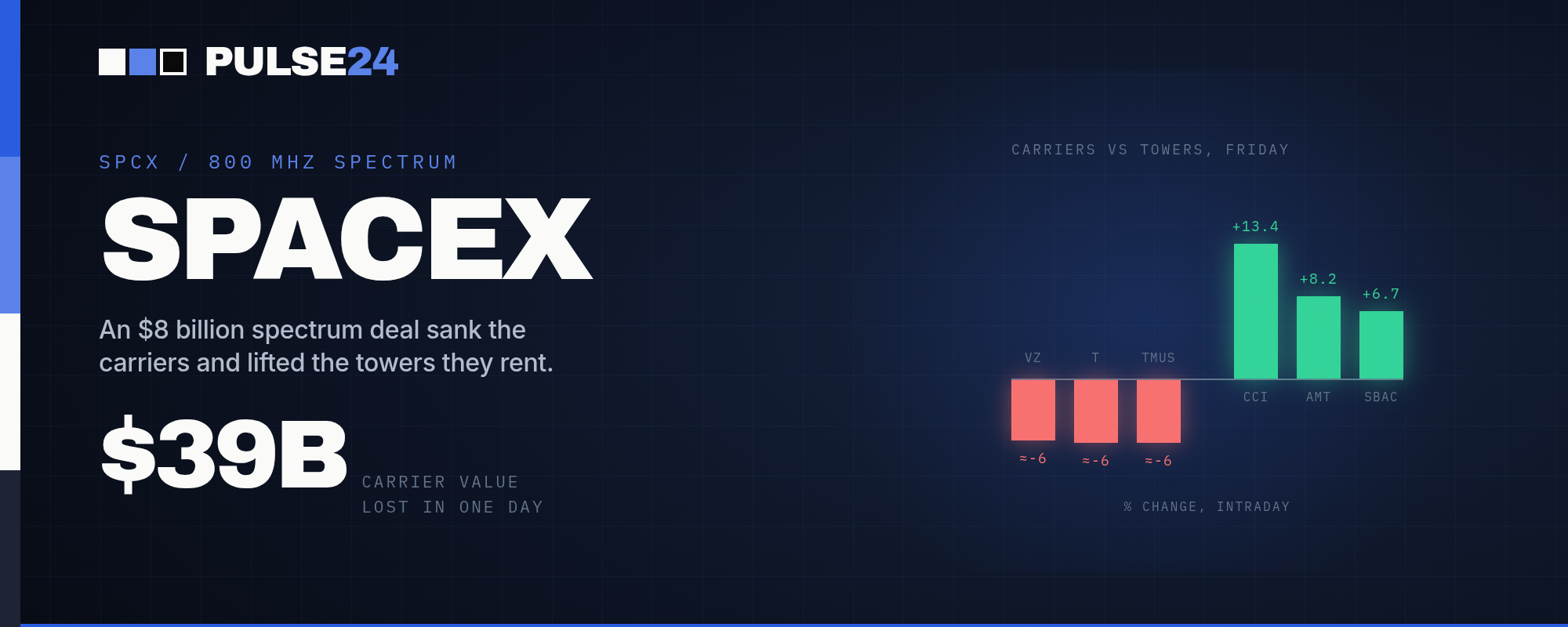
SpaceX agreed to pay roughly $8 billion for Grain Management's nationwide 800 MHz spectrum, and markets responded by wiping about $39 billion off AT&T, Verizon, and T-Mobile in a single session. Tower landlords like Crown Castle moved the opposite direction, jumping into double digits on the news.
SpaceX agreed on Thursday to pay roughly $8 billion in cash for Grain Management's nationwide 800 MHz spectrum portfolio, a band of low-frequency airwaves that most phones already support. By the next morning, AT&T, Verizon, and T-Mobile had shed a combined $39 billion in market value, while tower landlords that own none of the spectrum in question had added billions of their own.
The spectrum itself is modest on paper: up to 14 MHz of paired frequency, a sliver next to the hundreds of megahertz the three major carriers collectively hold. What rattled Wall Street wasn't the size. It was who bought it and why. Elon Musk's company wants the 800 MHz band to close what it calls one of the last technical gaps in Starlink's direct-to-cell service, the satellite link that currently offers texting and limited data through a T-Mobile partnership. Low-band spectrum travels farther and penetrates walls better than the higher frequencies satellites typically use, and that's the coverage problem Starlink needs solved if it wants to operate as an independent wireless carrier rather than a guest on someone else's network.
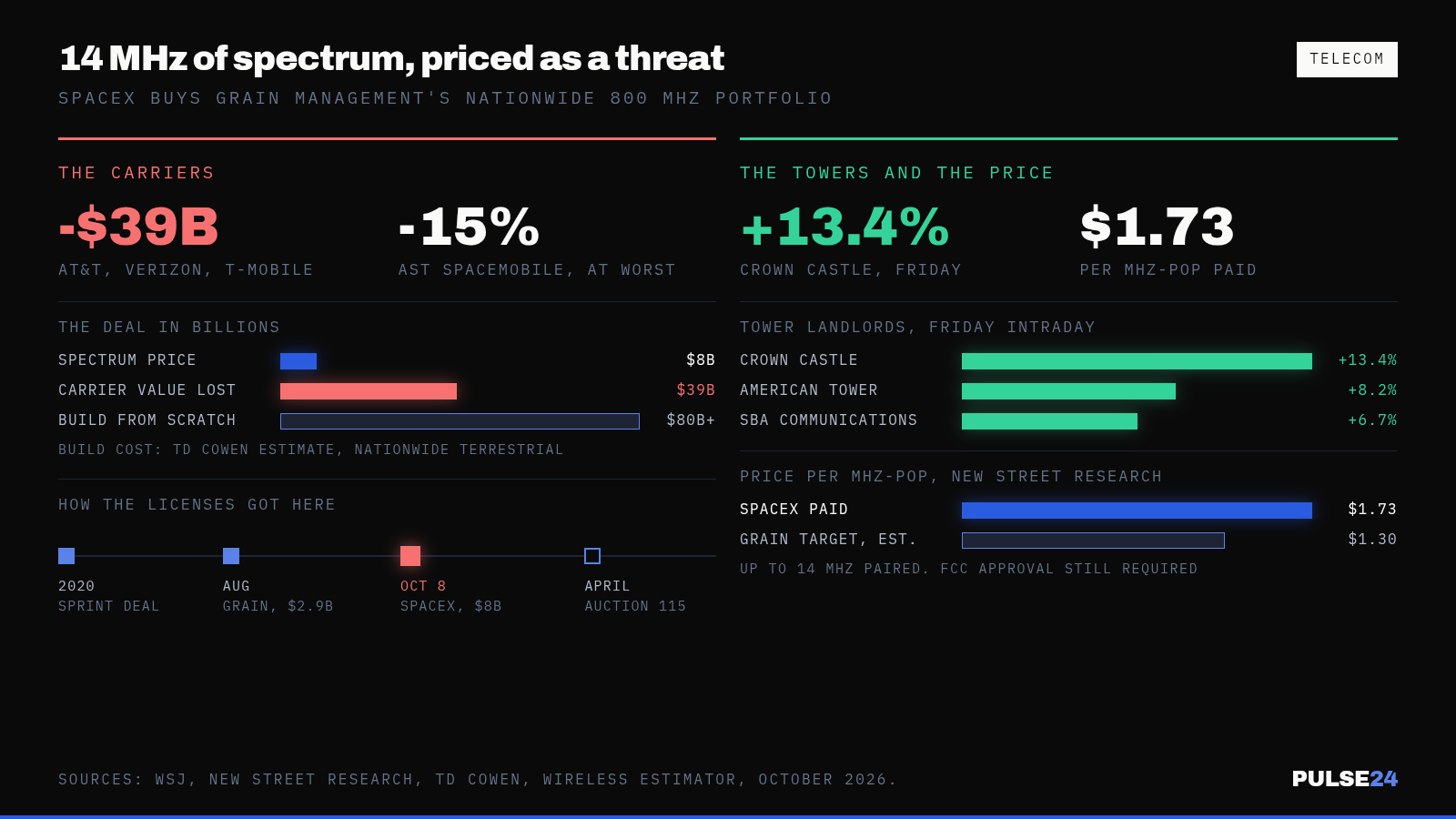
New Street Research's David Barden ran the math on what SpaceX actually paid: about $1.73 per MHz per point of population, above the roughly $1.30 figure he believed was closer to Grain's internal target when the firm first shopped the licenses earlier this year. That premium is itself a data point. It suggests a buyer with Musk's balance sheet and Musk's timeline was willing to pay up rather than wait for a cheaper deal or a future federal auction.
Why It Matters
The math behind the sell-off is more interesting than the headline number. TD Cowen's Gregory Williams points out that building a comparable nationwide terrestrial network from the ground up, towers, backhaul, permitting included, would cost SpaceX upward of $80 billion and take years it doesn't have. Buying spectrum from an existing operator is a shortcut, but New Street's Barden is skeptical it's the breakthrough Musk has framed it as. The 800 MHz band isn't even compatible with the satellites SpaceX currently has in orbit, which were built around 2 GHz frequency. AT&T, Verizon, and T-Mobile still collectively hold far more total spectrum than this one deal touches.
So why did three large, cash-generative companies lose $39 billion in a day over 14 MHz they never owned? Because the deal reframes the negotiation. LightShed Partners flagged the real prize: whichever carrier eventually signs a wholesale deal with Starlink Mobile gains both revenue and influence over how a brand-new competitor enters the market. The carriers had formalized their own spectrum-pooling joint venture only a week earlier, a defensive move that suddenly looks reactive rather than proactive. Musk now holds a card none of them anticipated, plus a credible, if contested, path to building his own network if none of them want to deal.
This isn't the first time SpaceX has moved capital at a scale that unsettles an entire sector. The company was separately reported seeking roughly $40 billion in financing, split between bank loans and investment-grade bonds, to buy Nvidia chips for its SpaceXAI data center business, a deal that surfaced against a backdrop of multi-decade-high Treasury yields. The spectrum purchase and the chip financing sit in unrelated parts of the business, but they share a pattern: Musk raising large sums quickly to remove a bottleneck before competitors can react, then letting markets sort out the price afterward.
What to Watch Next
The deal still needs FCC approval before it closes, and Grain hasn't given a target date. Regulators have attached buildout and performance conditions to recent satellite-to-phone spectrum transfers. AST SpaceMobile, which partners with AT&T and Verizon on its own satellite-to-phone service, had separately expressed interest in this same spectrum earlier this year, and its shares fell as much as 15% on the news, a sign investors see SpaceX's purchase as a direct competitive threat rather than just a carrier story. Watch the carriers' response too. Their executives have said publicly they don't want a wholesale arrangement with Starlink Mobile, but several analysts think a deal, not a standalone terrestrial build, remains the more likely outcome. Also circle Auction 115, the FCC's next spectrum sale next April: TD Cowen's Williams already flagged SpaceX as a newly serious bidder there, which changes the calculus for every carrier shopping for more capacity.
The Pulse24 Take
Fourteen megahertz is not a lot of spectrum. What moved $39 billion out of three of the largest companies in American telecom wasn't the asset itself, it was the buyer's willingness to pay a premium for it and the signal that sent about his intentions elsewhere. Markets are often better at pricing threats than at pricing certainties, and this is a clean example of that: nobody knows yet whether Starlink Mobile becomes a fourth national carrier, a wholesale partner, or a negotiating position that never ships a phone. The stock moves priced in the first scenario before any of the three outcomes is actually resolved.
The skeptics raise a real point too. Barden's observation about spectrum-satellite compatibility is not a small technical footnote. Direct-to-cell service that genuinely competes with terrestrial coverage needs more than owning the right frequency on paper. It needs satellites built to use that frequency, a buildout timeline measured in years, and regulatory sign-off that isn't guaranteed. The carriers didn't lose $39 billion because Starlink Mobile is definitely coming for their customers. They lost it because Wall Street just priced in the possibility, and possibilities move stocks faster than certainties ever do.
How we read the data
Curious how we get from raw data to a take like this? Our Trader's Toolkit walks through the tools we lean on.
Explore the Toolkit