Pulse24 Original
A Pokemon Card Sold for $16.5 Million. Its PSA 10 Grade Is Only Part of Why.
September 11, 2026
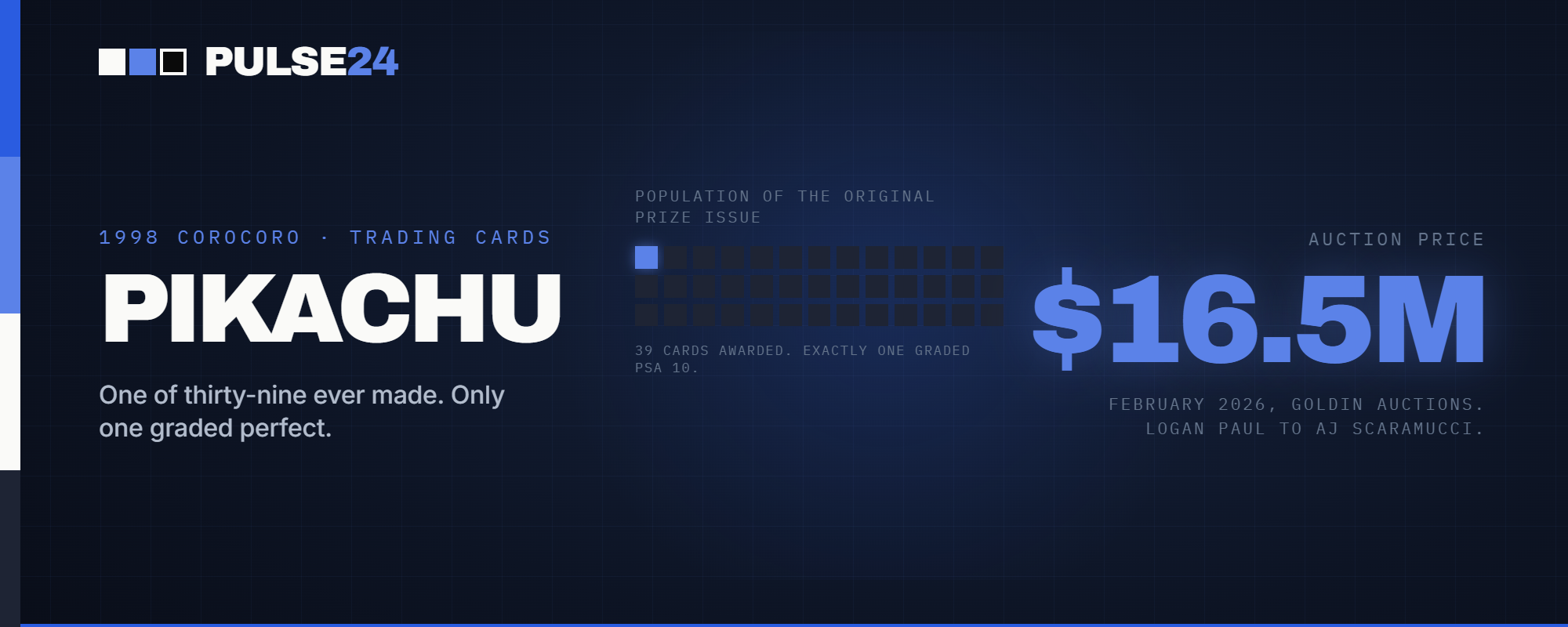
Logan Paul's PSA 10 Pikachu Illustrator sold for $16.492 million in February, the only known copy graded a perfect 10 out of just 39 originally awarded. The real story is what PSA grading, population reports, and provenance actually do to a collectible's price, and why a card with 21,000 identical-grade peers can still be worth thousands while this one sold for millions.
A cardboard rectangle with a cartoon mouse on it sold for $16,492,000 in February. Logan Paul acquired the Pikachu Illustrator card in 2021 by trading a PSA 9 copy of the same card, valued at $1.275 million, plus $4 million cash, a package worth $5.275 million combined. He had it set into a diamond-encrusted case and wore it around his neck at WrestleMania 38. Five years later, he auctioned it through Goldin Auctions in an online sale that ran more than a month. Bidding surged from roughly $6 million to a $13.3 million winning bid in the final hours before buyer's premium brought the total to $16,492,000. The sale broke three Guinness World Records at once.
The obvious explanation is the grade on the case: PSA 10, gem mint, the highest score the company gives out. But this card would have been worth a fortune without that label. Its story starts well before any grading company opened the envelope.
What a PSA 10 Actually Certifies
Only 39 Pikachu Illustrator cards were originally awarded, given out as prizes in a 1998 illustration contest run through CoroCoro Comic, a Japanese manga magazine, rather than sold through any retail channel. A couple more have surfaced since, but the population has always been a small, fixed number, not something Nintendo or The Pokemon Company could reissue if demand rose.
What PSA added is more specific than "rare." Roughly 30 of the known copies have ever been submitted for grading, and exactly one, Paul's, has come back a Gem Mint 10. The grade didn't manufacture scarcity out of nothing. It found the single sharpest edge inside a scarcity that already existed, and gave it a label a buyer on the other side of the world could trust without ever holding the card.
The Number That Matters More Than the Grade
The story usually gets oversimplified into "PSA 10 beats PSA 9, therefore expensive." The more useful number is population, meaning how many copies of a specific card have received a specific grade, and population interacts with demand in ways that don't all point the same direction.
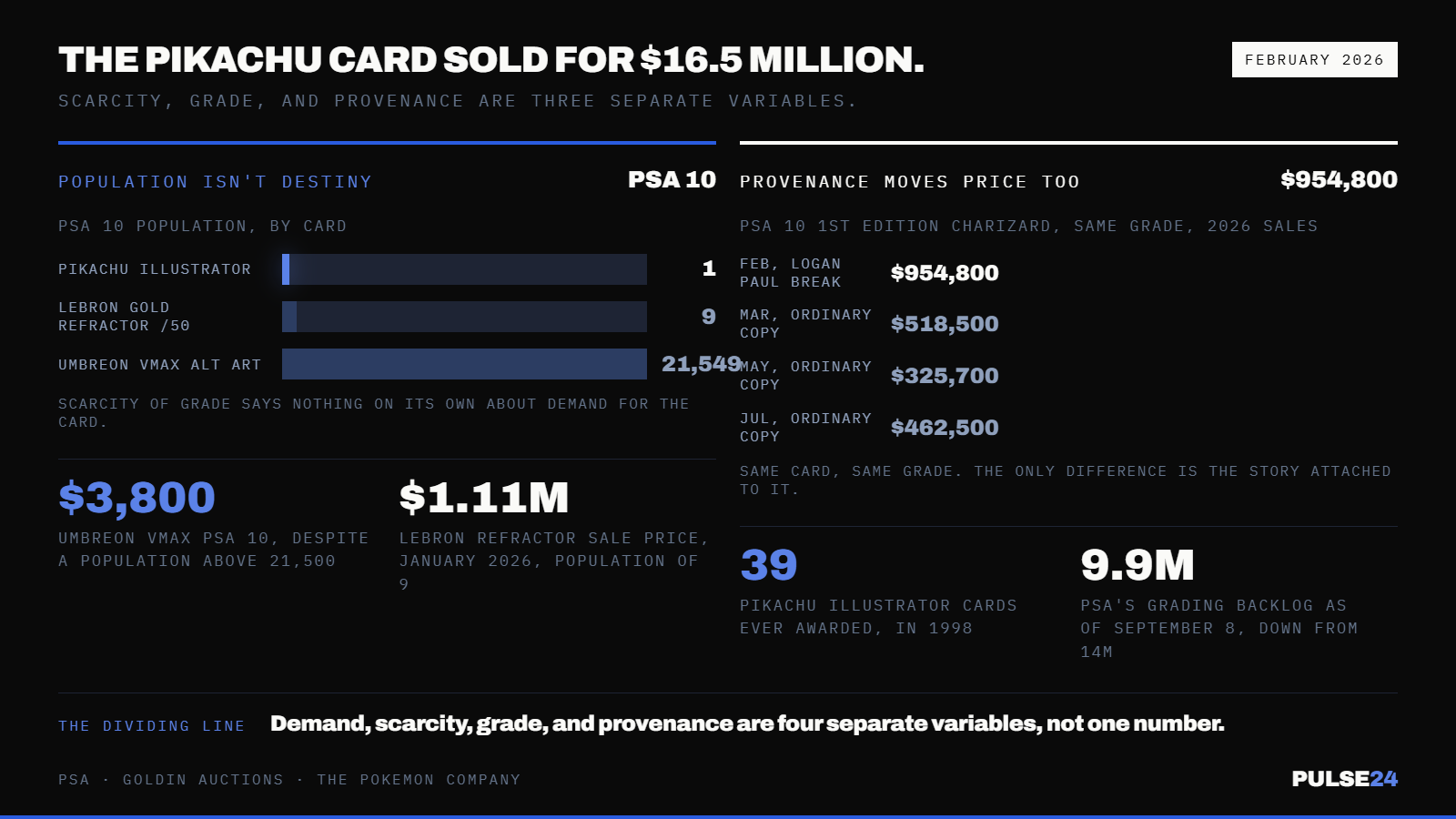
Take the Evolving Skies Umbreon VMAX alternate art, arguably the most recognized modern Pokemon chase card of the last five years. PSA has graded more than 21,500 copies of it a perfect 10. Population logic alone would suggest that makes a PSA 10 copy cheap. It still trades for roughly $3,800, down from about $4,950 in June, a pullback but nowhere near a bulk-bin price. Demand for one specific, culturally iconic card can absorb a population in the tens of thousands and still support a four-figure price.
Compare that to a 2003 Topps Chrome LeBron James Gold Refractor, numbered 6 of 50, with a PSA population of just 9 at Gem Mint. That card sold for $1.11 million in January. Nobody would argue a population of 9 alone explains a seven-figure price if the subject were a replacement-level player instead of one of basketball's most collected figures. Scarcity sets a ceiling on how many copies exist at a given quality. Demand, tied to who or what the card actually depicts, decides how expensive hitting that ceiling gets.
A useful way to hold these ideas together: card value sits at the intersection of four separate things, demand for the underlying card, scarcity of the card itself, scarcity at a particular grade, and provenance. They're independent variables, not one number you can multiply out. Pikachu Illustrator has extreme scarcity on both the card and the grade at once. Umbreon's alt art has enormous graded supply paired with enormous demand. The LeBron refractor has a tiny original print run paired with enormous demand for the player himself. Change any one of the four and the market can move dramatically.
The Backlog, the Fees, and What's Actually Behind Them
None of this scarcity math functions as a market without a grading company standing behind it, which is why PSA's own operational strain matters to collectors well beyond this one card.
PSA's backlog of ungraded submissions peaked near 14 million cards earlier this year. It has since fallen to 9.9 million as of September 8, down from 10.9 million the week before, as the company's five grading hubs work through the queue. PSA announced a $200 million infrastructure investment in May to expand capacity. Separately, and not necessarily as a direct result of that announcement, submissions spiked 20% around the same period, adding roughly 1.6 million cards to an already strained pipeline and pushing PSA to pause its cheapest tiers in June.
The lowest tier still open today costs $79.99, more than triple the $24.99 entry price that existed before the pause. At that price, many lower-value modern cards become difficult to justify grading purely for resale, though the math still depends on a card's acquisition price, expected grade, and eventual selling fees.
The Vintage-Modern Split, Reconsidered
It's tempting to explain the gap between vintage and modern card prices as simple oversupply: Pokemon prints too many cards, so newer ones stay cheap. The production data doesn't actually support that story. The Pokemon Company printed about 10.2 billion cards in the fiscal year through March 2025, down 14% from roughly 11.9 billion the year before. The following fiscal year, through March 2026, production landed even lower, around 10 billion, and the company has described that figure as a ceiling set by capacity, not a deliberate flood. It's building a new 1.27 million square foot printing facility, expected to open in 2028, specifically because it can't keep up with demand as things stand.
What actually pushed modern card prices lower this year looks more like a demand-side unwind than a supply glut. Some high-profile singles and sealed products from recent sets have pulled back materially as retail availability improved and speculative demand from short-term flippers cooled. Umbreon VMAX's alternate art offers one concrete, verified example: despite a PSA 10 population above 21,500, its price slipped from roughly $4,950 in June to about $3,800 by September, close to a 23% pullback. Vintage cards haven't followed modern cards lower, because a 1999 print run can't be topped up no matter how much new product ships in 2026. The original run is fixed. What can still change is the graded population of that fixed run, since ungraded copies sitting in shoeboxes keep surfacing and entering PSA's queue decades later.
What to Watch Next
PSA has said it will consider reopening a paused low-cost tier if its backlog keeps falling. Watch what gets submitted if that happens. A fresh wave of modern cards flowing back into the grading pipeline would swell PSA 10 populations that are already large, the way Evolving Skies' Umbreon alt art already sits above 21,500. Whether that compresses modern-card premiums further depends on whether demand for those specific cards keeps pace, the same dynamic that's kept the Umbreon alt art from collapsing to a bulk-bin price despite its size.
Also watch how much provenance alone can distort prices at the very top, independent of grade or population. A PSA 10 1st Edition Charizard carrying documented "Logan Paul Break" provenance, pulled during a live box-opening event tied to Paul, sold for $954,800 in February. Other PSA 10 copies of the same card, same grade, sold for far less in the months after: $518,500 in March, $550,000 in April, $325,700 to $362,900 in May, $343,098 in June, $462,500 in July. Same card, same label, a gap of hundreds of thousands of dollars, and the only real difference is the story attached to one specific copy.
The Pulse24 Take
The Pikachu Illustrator didn't become worth $16.5 million because a plastic case said 10 instead of 9. It became worth that much because a card from an original distribution of just 39 copies, most never even submitted for grading, happened to have exactly one example graded perfect, owned by someone famous enough to auction it as a spectacle. Grading didn't create any of that. What it did was turn a subjective argument, how nice does this specific piece of cardboard actually look, into a standardized piece of information that a stranger could trust without touching the card themselves. That's the same problem gold's purity stamps and bond ratings solve for very different assets: getting two strangers to agree on exactly what's being traded before money changes hands. Pokemon cards, sports cards, and the graders behind them are still building that infrastructure in real time. That's why a card with more than 21,000 PSA 10 peers can still be worth $3,800, while the only PSA 10 from a 39-card trophy issue can sell for $16.5 million. The number on the slab matters. What sits behind that number matters more.
How we read the data
Curious how we get from raw data to a take like this? Our Trader's Toolkit walks through the tools we lean on.
Explore the Toolkit