Pulse24 Original
A $200 LEGO Set Is Now Worth $450. Most LEGO Investments Look Nothing Like It.
September 12, 2026
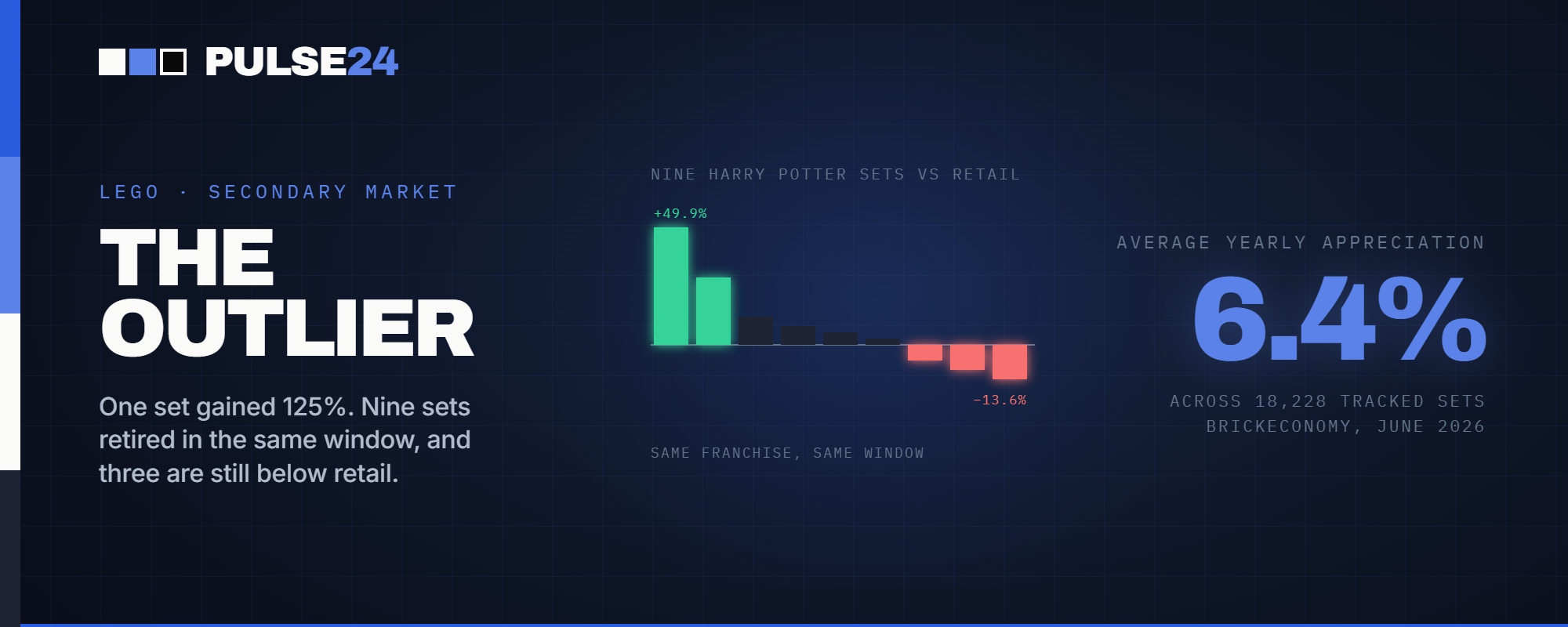
A LEGO Harry Potter set now valued at $450 is up 125% from its $199.99 retail price, but most of that gain arrived in a short window around its retirement, not steadily over time. BrickEconomy's broader database of more than 18,200 tracked sets shows the real average is 6.4% a year, a very different number from the one usually quoted.
Hogwarts Castle: The Great Hall is worth about $450 today, according to BrickEconomy. It retailed for $199.99 when it launched in mid-2024. That is a 125% gain, and it is the kind of number that makes "LEGO as an investment" a recurring headline.
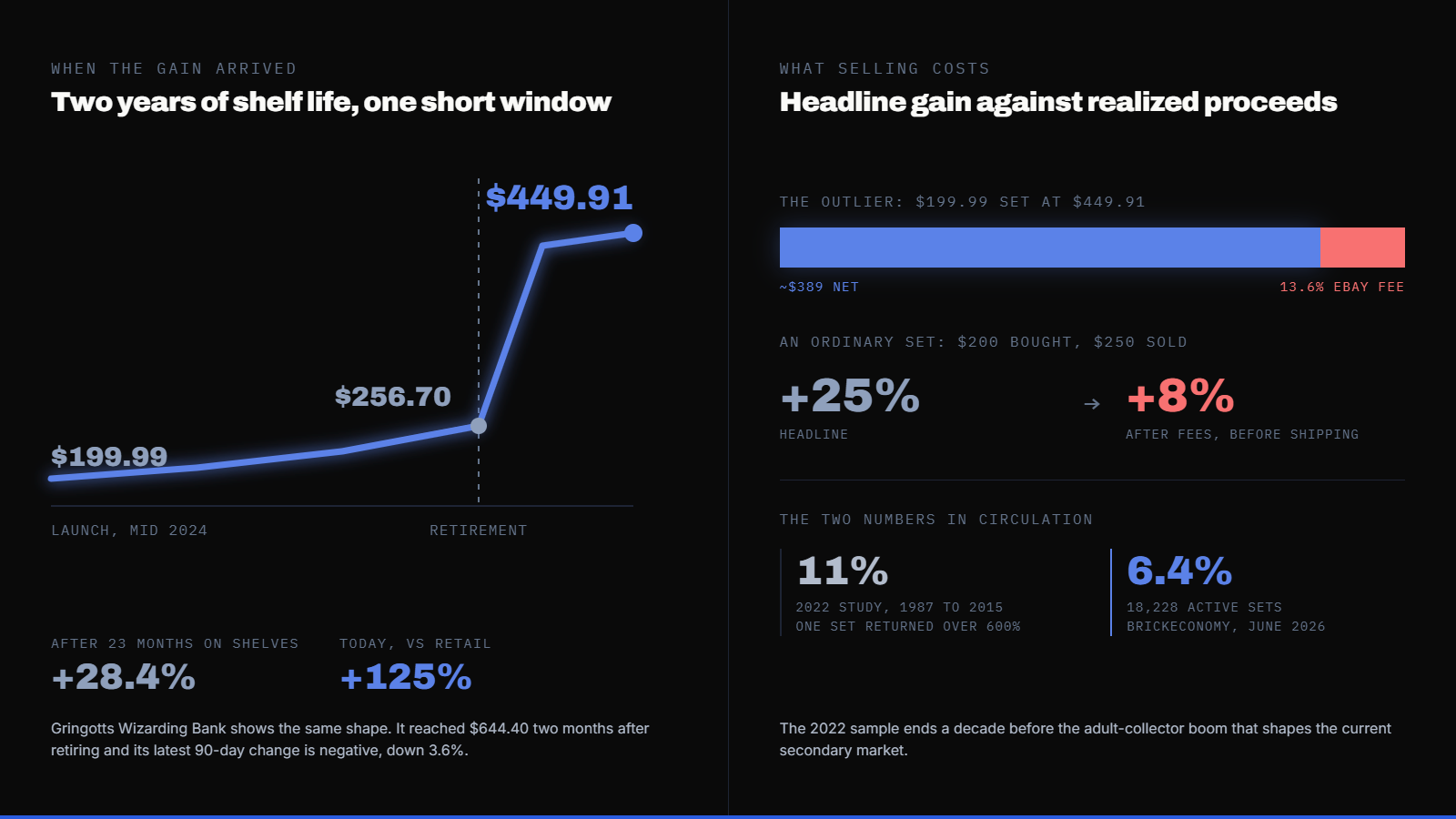
But the 125% figure hides when the gain actually happened. BrickEconomy's own analysis, published in May 2026, a month before the set retired, already had it at $256.70, a 28.4% premium after about 23 months on shelves. The jump from there to $449.91 happened in a short window in and around the set's June retirement, not across the full two years the 125% figure implies.
The 125% Number Needs Context
BrickEconomy tracks two different numbers for a set like this, and they tell different stories. One is cumulative growth against the original retail price, the 125% figure. The other is annualized appreciation since a specific point in time, and BrickEconomy currently puts the Great Hall's annual appreciation at 6.05% since retirement. Those are not competing estimates. They measure different things: a total move since launch, and a rate of change since a later starting point.
A LEGO Harry Potter collector's set retired in March 2026 shows a different pattern. Gringotts Wizarding Bank now sits at $649.98, up 51% from its $429.99 retail price. But by May 7, barely two months after retirement, BrickEconomy already valued it at $644.40. The set has added almost nothing since; its current 90-day change is actually negative, down 3.6%. Most of the premium investors see today was already in place very early in its post-retirement life.
Why Some Sets Separate From the Market
BrickEconomy's broader database, covering 18,228 active sets in its June market recap, puts average yearly appreciation at 6.4%. That is a much better starting point for understanding the category than selecting a handful of sets that doubled, though it is BrickEconomy's own tracked-market metric rather than a formally investable financial index, and it is not directly comparable to the total return of one. It is still a very different number from 125%, and the gap is why a handful of standout sets keep generating headlines that do not describe what happens to most sets.
Even the Harry Potter name alone does not guarantee anything. Among nine Harry Potter sets on BrickEconomy's 2026 retirement watch, Gringotts stood 49.9% above retail and Great Hall 28.4% by early May. Several others in the same cohort were still below their original retail price: The Sorting Hat was down 13.6%, Hagrid & Harry's Motorcycle Ride was down 10%, and Hogwarts Castle: Flying Lessons was down 6.2%. Same franchise, same retirement window, nine very different outcomes.
What separates a Great Hall or a Gringotts from an average City or Friends set, or from the weaker sets in its own franchise, is not fully knowable from the outside. LEGO does not publish print runs by set, so claims about how limited a particular run was are inference, not documented fact. What can be said with more confidence: how much collector demand a theme carries, how close to MSRP buyers actually paid during a set's retail life, and how much supply shows up on the secondary market once holders decide to sell, all move the number more than the sticker price does. Someone who bought Great Hall at a discount during its run started from a different number than someone paying full retail after it sold out, and both differ from someone buying it today at $450.
The Study Behind "LEGO Beats Stocks"
The most-cited data point behind the "LEGO beats the market" claim comes from a 2022 paper in Research in International Business and Finance, which tracked set prices from 1987 to 2015 and found an average annual return of at least 11%, or 8% after inflation, outperforming large stocks, bonds and gold across that period. It is a real, peer-reviewed result.
The return distribution was also highly skewed, with extreme winners including at least one annual return above 600%. In a distribution like that, the mean can look very different from the experience of a typical set. A median return, the number half the observations exceeded and half fell below, would be useful context alongside the headline average, though it is not the figure usually quoted. And the sample ends in 2015, a decade before the adult-collector boom that shapes today's secondary market even started, which limits how much the 11% figure says about the market as it exists now.
The Cost the Charts Don't Show
None of the numbers above account for what it actually costs to turn a sealed box back into cash. Selling on eBay runs 13.6% in final value fees for most sellers, or 12.7% for sellers on a Basic-or-higher store subscription, before shipping and any years of storage are counted. Apply roughly 13.6% to Great Hall's $449.91 valuation and proceeds fall to about $389 before the per-order charge, shipping and storage, still a large gain against a $199.99 set, but a meaningfully smaller one than the headline 125% suggests.
The effect is much larger on ordinary sets. A set bought for $200 and resold for $250, a 25% headline gain, nets roughly $216 after a 13.6% fee, before shipping. That is closer to an 8% realized return, not 25%. Fees do not just trim the top-line number. On modest gains, they can erase most of it.
The Pulse24 Take
LEGO can absolutely be collectible. That does not make LEGO an asset class. A $200 set becoming worth $450 makes a great headline. A database of more than 18,000 sets averaging 6.4% a year, before fees, shipping and the years some of those boxes sit in a closet, tells a different story, and it is the more representative one. The winners are real. So are the ordinary sets that never become one.
Some collector-oriented sets can double or triple in secondary-market value. Explaining why, after the fact, is straightforward: demand for the theme, how much supply appeared on the secondary market, and how retirement timing lined up with collector attention. Identifying which set does that before it retires is a much harder problem, and nothing in Great Hall's or Gringotts' charts, or the eight other Harry Potter sets that retired alongside them, solves it in advance.
How we read the data
Curious how we get from raw data to a take like this? Our Trader's Toolkit walks through the tools we lean on.
Explore the Toolkit