Pulse24 Original
Judge Leonie Brinkema Rejected a Forced Breakup of Google's Ad Business. Nine Months Earlier, a Different Judge Made the Same Call on Google Search.
September 6, 2026
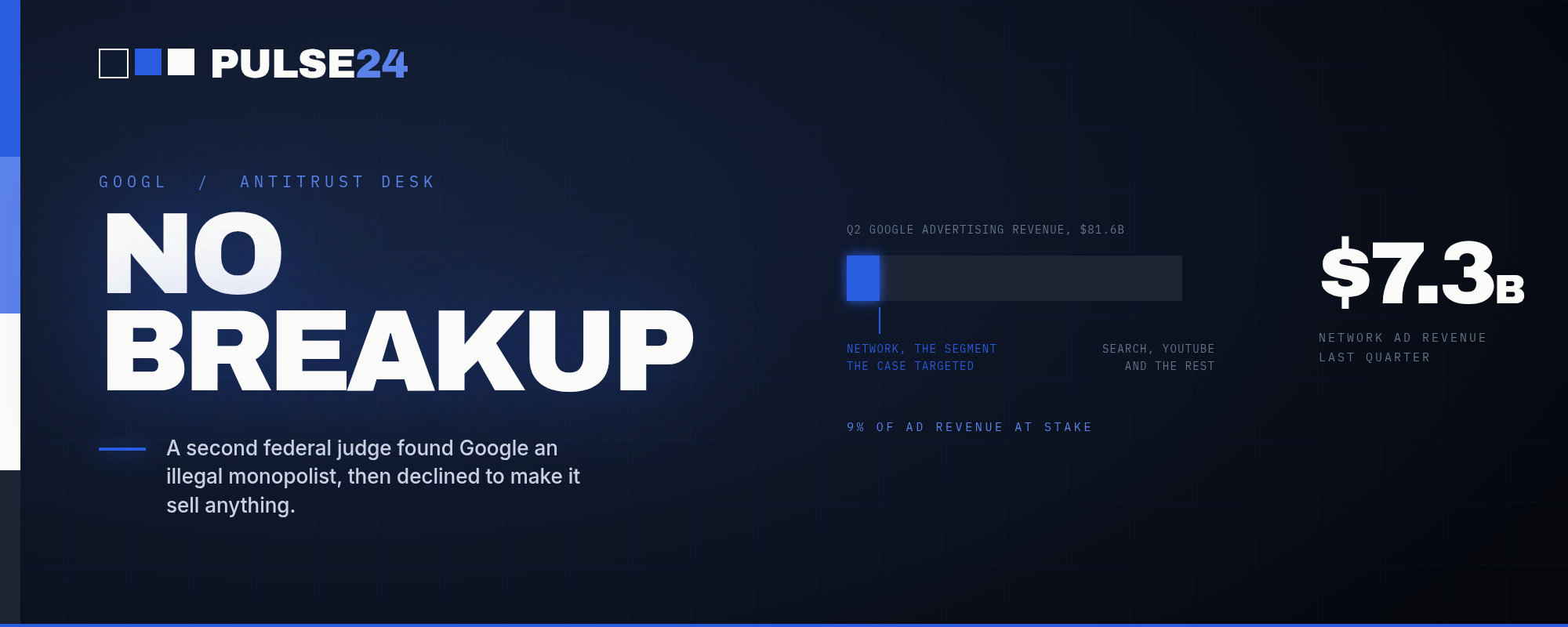
A federal judge just rejected the Justice Department's push to break up Google's ad-tech business, ordering rule changes instead of a forced sale of its ad exchange. It's the second time in less than a year a U.S. court has found Google guilty of illegal monopoly power and declined to dismantle the company anyway.
Google's ad-tech business survived a breakup order this week, and the reason has as much to do with a small publisher's free ad server as it does with antitrust doctrine. On September 2, U.S. District Judge Leonie Brinkema in the Eastern District of Virginia ruled that Google had illegally monopolized parts of the online advertising stack, then declined to order the one remedy the Justice Department wanted most: forcing Google to sell its AdX exchange and DFP ad server.
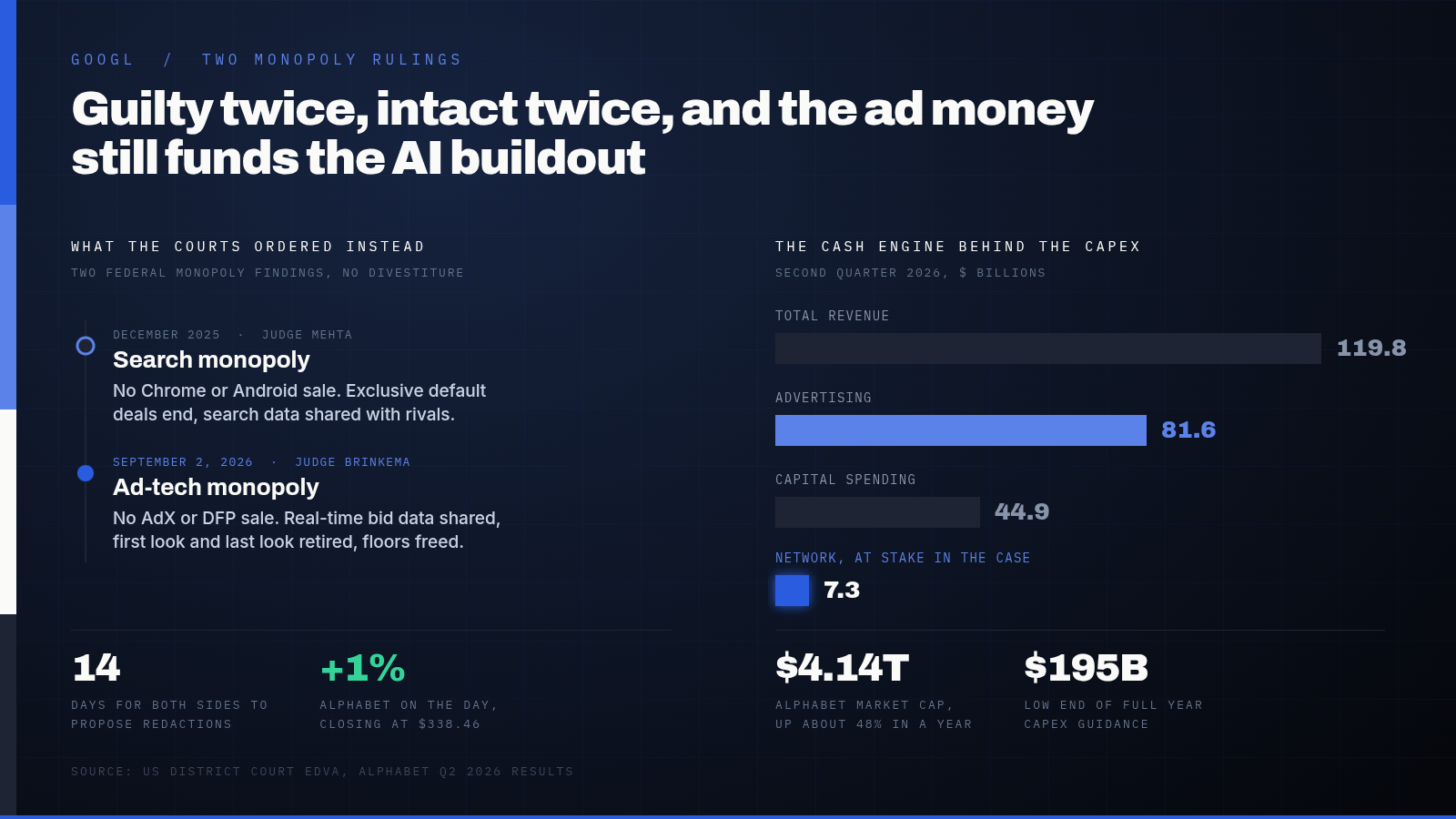
Instead, Brinkema ordered a set of operating changes. Google must share real-time bid amounts for open-web display ads with competing ad servers, stop using "first look" and "last look" privileges that let its own systems see and react to rival bids, retire its Unified Pricing Rules, and let publishers set different price floors for different bidders inside Google Ad Manager. The judge reasoned that a forced sale could hurt small publishers who rely on DFP's free tier, and that behavioral fixes would reach the market faster than years of appeals over a divestiture.
What Changed
This is the second time in less than a year that a federal court has found Google guilty of running an illegal monopoly and then stopped short of breaking the company up. Judge Amit Mehta reached a similar conclusion in Google's separate search antitrust case: he ruled the company had illegally maintained its dominance in search, but when remedies were finalized in December 2025, he rejected forcing Google to divest Chrome or Android. Instead he ordered Google to end exclusive default-placement deals and share certain search data with rivals. Two major monopoly findings, two decisions to leave the underlying business intact.
Google's own statement leaned into that framing. VP of regulatory affairs Lee-Anne Mulholland said the company was "very pleased the Court rejected the DOJ's proposal to break apart tools that help small businesses reach new customers and grow." Ad-tech rival PubMatic took the opposite tone but similar comfort, saying it hoped the "adoption of behavioral remedies should establish a level playing field." Jay Friedman, a DOJ witness and co-founder of CartographAI, was less convinced, noting that publishers still can't switch away from Google's ad server while keeping access to its advertiser demand.
Why It Matters
Wall Street's reaction was calm, which is itself informative. Alphabet shares rose roughly 1% the day of the ruling and closed at $338.46 on September 4, putting the company's market cap at $4.14 trillion, about 48% above where it traded a year earlier. A breakup of AdX and DFP would have hit Google's "Network" advertising segment, the part of the business the case actually targeted, which brought in $7.3 billion last quarter. That's real money, but it's a small slice of the $81.6 billion Google generated in total advertising revenue during the second quarter, itself part of $119.8 billion in company-wide revenue that grew 24% year over year.
The reason that ad revenue matters goes beyond Google's own income statement. Alphabet spent $44.9 billion on capital expenditures in the second quarter alone and has guided toward $195 billion to $205 billion for the full year, most of it aimed at AI infrastructure: data centers, custom chips, and the power contracts needed to run them. Advertising is the cash engine paying for that buildout, which puts Google in a different financing position than some of its rivals. Five hyperscalers are on pace to borrow $175 billion this year for AI alone, leaning on debt markets in a way Google's ad-funded model doesn't require. A ruling that preserved Google's ad-tech revenue, even narrowly, preserved some of that funding advantage too.
What to Watch Next
Brinkema's order is still partially sealed. Both sides have 14 days from the ruling to propose redactions and specific implementation language, so the exact mechanics of how rival ad servers get access to Google's bid data won't be public until roughly mid-September. Watch for whether the Justice Department appeals to the Fourth Circuit, and whether PubMatic and other independent ad-tech firms see any real shift in market share once the rules take effect, or whether publishers stay effectively locked into Google's ecosystem no matter what the new rules say on paper.
The Pulse24 Take
Two monopoly rulings, two decisions not to break up the company. That isn't proof courts have gone soft on Big Tech so much as it's a pattern: judges seem more comfortable finding illegal conduct than they are unwinding a company's structure to fix it, especially when the harm a rushed divestiture could do to small publishers or independent developers is easy to argue and hard to rebut.
For markets, the read is fairly direct. Regulatory overhang on Alphabet got lighter this week, and the cash that funds its AI spending stays exactly where it was. That's a tailwind for one hyperscaler's balance sheet, but it doesn't answer the bigger question hanging over the whole AI buildout: whether the returns on all that capital expenditure, debt-funded or ad-funded, show up before investors lose patience with paying for it.
How we read the data
Curious how we get from raw data to a take like this? Our Trader's Toolkit walks through the tools we lean on.
Explore the Toolkit