Pulse24 Original
Why F1 Drivers Weave Before a Race Start. It's Mostly About Tires, Not Brakes.
September 4, 2026
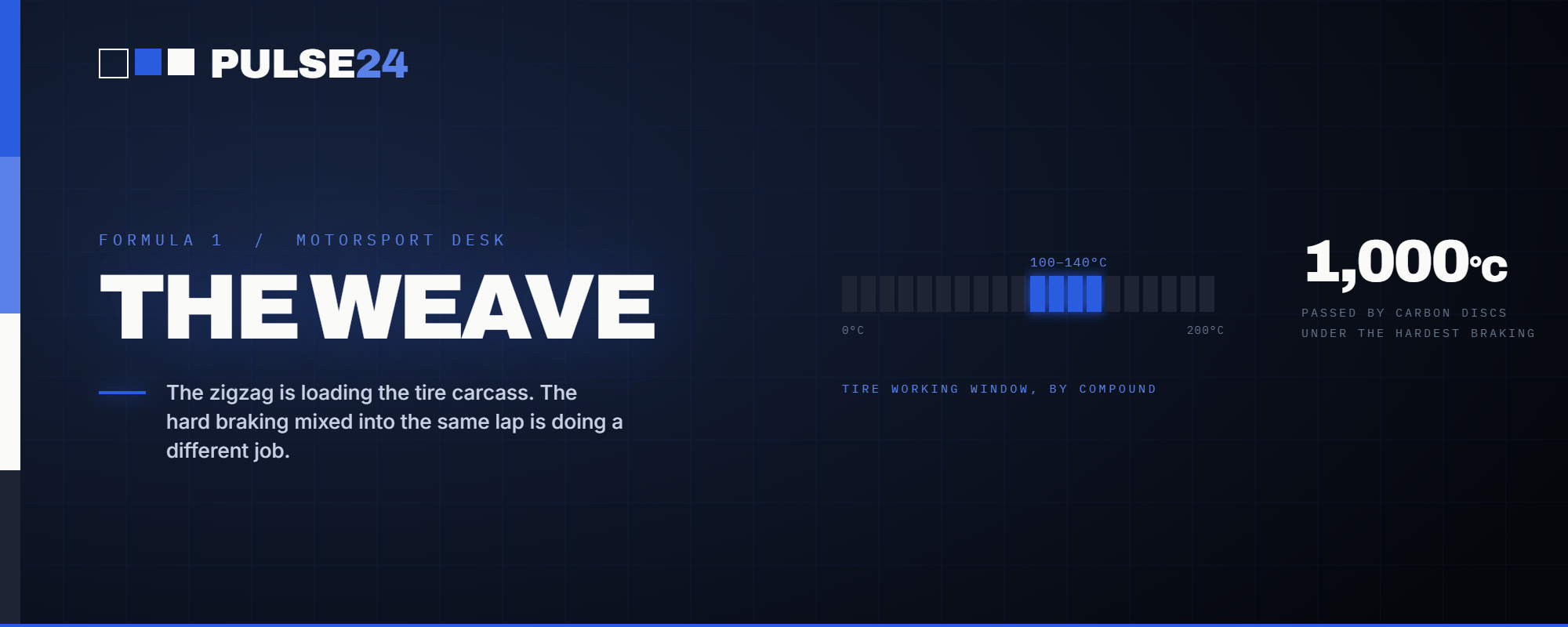
Why do Formula 1 cars zigzag on the formation lap? The weaving is mainly about building tire temperature. The aggressive acceleration and braking happening at the same time is doing a different job entirely: getting the carbon brakes ready for Turn 1.
Every Formula 1 broadcast shows the same shot before a race start or a restart: a line of cars swinging left and right in short bursts. It looks like one motion, but it's actually two separate routines happening at once. Steering inputs are warming the tires. Bursts of acceleration and hard braking mixed into the same lap are warming something else entirely: the carbon brakes. Confusing the two, as if a driver zigzags to heat both systems the same way, misses what's actually going on.
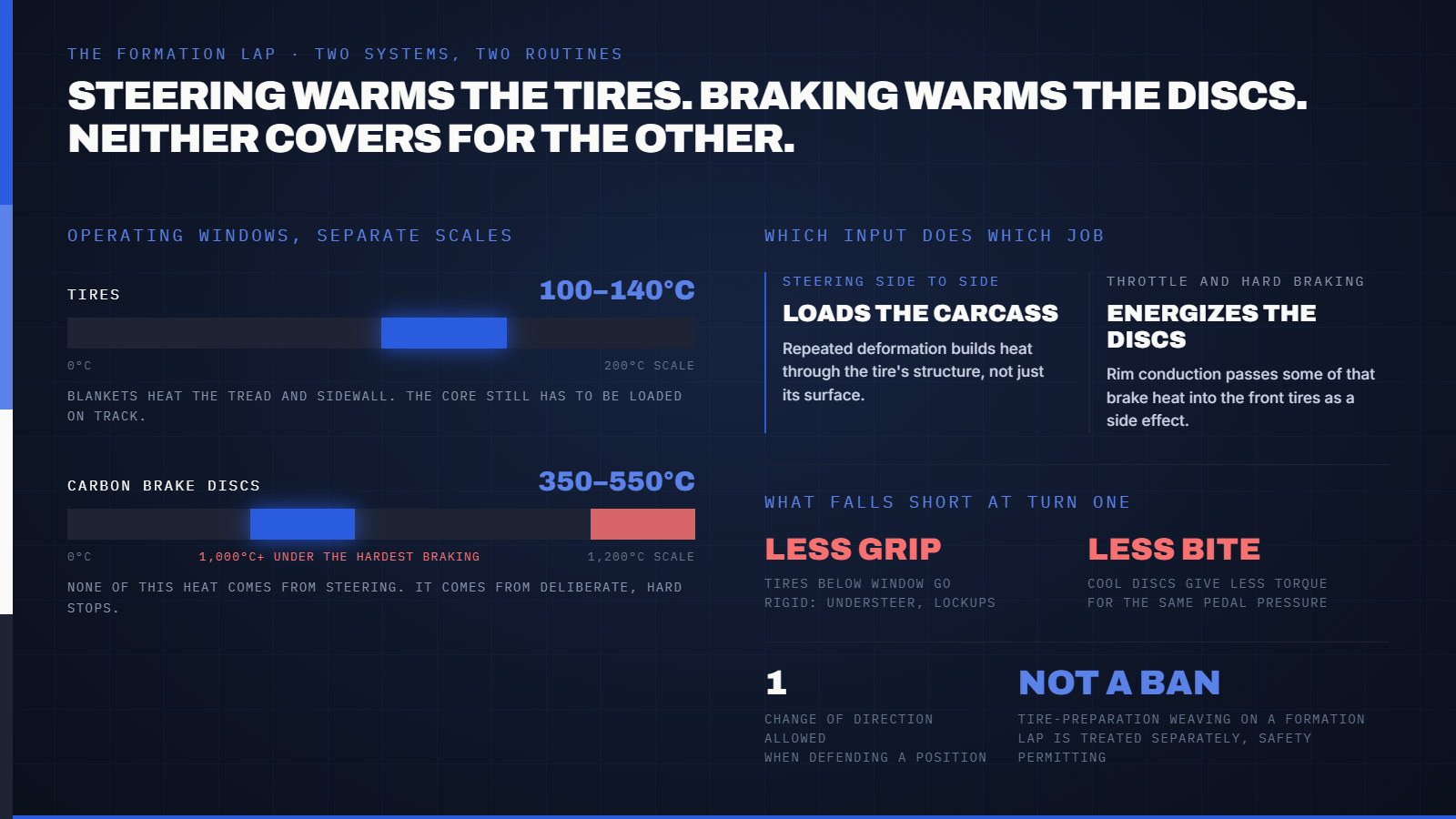
The tires are the main reason for the visible zigzag. Formula 1's technical material has described the working window as roughly 100°C to 140°C depending on the tire compound, though the exact target varies with tire specification and conditions. Tire blankets get the process started, heating the tread and sidewall from the outside before a car ever leaves the garage. But blankets can't reach deep enough into the tire's core to bring the whole structure up to temperature, so the car still has to do the rest of the job on track.
How Drivers Warm the Tires
Loading is the mechanism that matters here, not surface friction on its own. As a tire is steered and flexed side to side, its carcass bends and then pulls itself back into shape, and that repeated deformation helps build temperature through the tire's structure rather than merely heating its surface. A tire that's too cool goes rigid at the surface, which is why a driver who skips the weave can feel the front end go vague under braking into the first corner. Teams can also use some of the heat generated by braking, conducted through the wheel rims, to help bring the front tires up to temperature, since the driven rear tires generally warm more easily through engine power alone.
Brake Warming Is a Different Job
F1's carbon-carbon brake discs need real heat to work well. Brembo describes their optimal operating window as roughly 350°C to 550°C, with temperatures capable of exceeding 1,000°C under the hardest braking. None of that heat comes from steering the car side to side. It comes from braking, which is why the formation lap includes noticeably hard, deliberate stops mixed in with the weaving rather than a smooth, constant-speed procession.
That distinction matters because the two systems can fall out of sync. A driver can have the tires close to their target window while the brakes remain cooler than desired, or the other way around. Engineers monitor both readouts separately during the formation lap because preparing one system doesn't guarantee the other is ready.
Why It Matters on Track
A driver who shows up to the first braking zone with either system short of temperature loses performance exactly when it counts most. Tires below their working window are less compliant and generate less grip, which shows up as understeer, a locked wheel, or a car that simply doesn't rotate the way it did in practice. On the brake side, carbon discs below their operating window produce less friction and therefore less braking torque for the same amount of pedal pressure. That makes the first heavy stop after a formation lap or a neutralized period particularly sensitive to how well a driver prepared the system beforehand.
The Rules Around Weaving
Tire-preparation weaving and defensive weaving are treated differently, and it's worth knowing the difference. FIA rules prohibit more than one change of direction when a driver is defending a position on track, while a move designed to break another car's tow can be assessed differently depending on the gap and relative speed between the two cars. Neither rule amounts to a blanket ban on lateral movement to prepare tires during a formation lap or a safety car period, though drivers remain subject to the usual requirements around safety and not impeding other cars.
What to Watch For
Once you know what to look for, a formation lap stops being dead time on the broadcast. Watch the front wheels for the sharpest, most frequent direction changes, since that's tire preparation in progress. Separately, listen for the engine note: a driver burying the throttle and then braking hard, sometimes noticeably harder than the moment calls for, is primarily working the brakes, although those same accelerations and stops put some energy into the tires as well.
Wet and cold conditions change the calculation further. A cold track draws heat out of both systems faster than a warm one does, which is part of why weaving tends to look more aggressive on a chilly morning session than a hot afternoon one. In the wet, the bigger challenge shifts toward simply keeping intermediate or wet tires in a workable range at all, since a cold, damp track pulls heat from the tires quickly regardless of how a driver is preparing them.
Safety car restarts add one more layer. Every car on track is trying to rebuild tire and brake temperature while holding a prescribed gap to the car ahead, and those constraints don't fall evenly on the field: a car that got bunched up in traffic has less clean track to work with than one running in open space. Those differences can matter immediately after the restart, when one driver has enough tire temperature to attack into the first braking zone while another spends several corners easing the car back toward its preferred window.
The Pulse24 Take
A formation lap is one of those parts of Formula 1 that looks uneventful until you know what a driver is actually managing. The steering tells you something about the tires. The braking tells you something about the carbon discs. Neither one guarantees the other is ready.
Once you start watching it that way, those ninety seconds before the start become a preview of turn one: who has generated enough grip, who has the brakes prepared, and who might still be asking the car for performance it isn't quite ready to give.
How we read the data
Curious how we get from raw data to a take like this? Our Trader's Toolkit walks through the tools we lean on.
Explore the Toolkit