Pulse24 Original
Williams F1 Sold for $200 Million in 2020. Forbes Now Values It at $2.7 Billion.
September 21, 2026
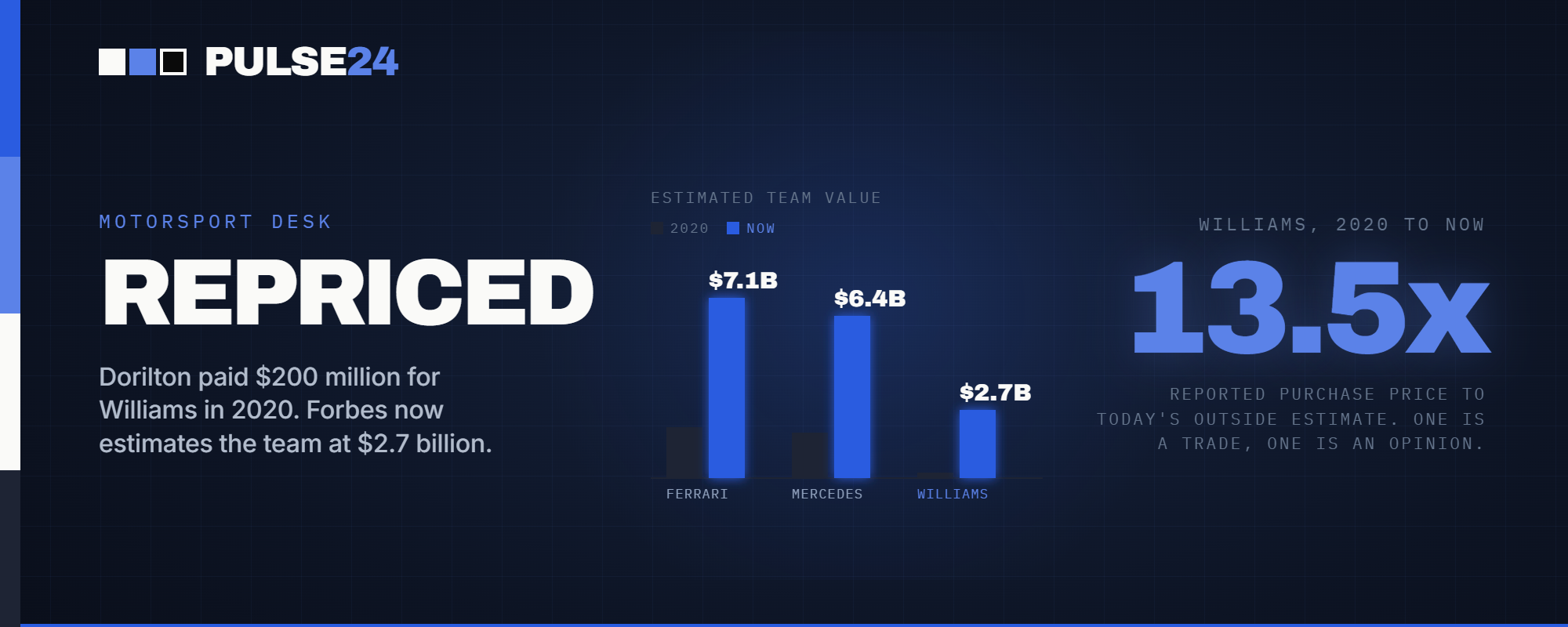
F1 team valuations have multiplied since 2020 as private equity, sovereign wealth funds and sports investors have joined manufacturers in competing for a fixed number of grid slots. The deals behind the repricing, and what would have to keep happening for today's multiples to hold up.
Dorilton Capital bought Williams Racing for $200 million in 2020, according to Bloomberg's reporting at the time. Forbes now estimates the team is worth $2.7 billion, 13.5 times the reported purchase price. The two numbers aren't quite the same kind of evidence: one is a completed transaction, the other an outside analyst's estimate of what a future sale might fetch. Even accounting for that gap, the repricing across F1 is too broad to be one transaction's fluke. The change wasn't primarily sporting. The economics of owning an F1 entry changed.
Every team that's raced continuously in F1 since 2020 has seen its estimated value climb several times over, according to Forbes-derived figures: Ferrari from about $2 billion to $7.1 billion, Mercedes from $1.8 billion to $6.4 billion. McLaren offers a transaction-based comparison of its own, though it's a slightly different measurement: McLaren Racing, the group that also fields IndyCar and, from 2027, World Endurance Championship entries alongside its F1 team, was valued at roughly £560 million when outside investors bought in during 2020 and about £3.5 billion when those minority stakes were bought out in 2025. Institutional and sports-focused capital, private equity firms, sovereign wealth funds, and billionaires who already own franchises in other leagues, has joined manufacturers like Ferrari, Mercedes, Red Bull, and Audi as prominent owners on the grid, rather than replacing them.
The Cost Cap Changed the Economics
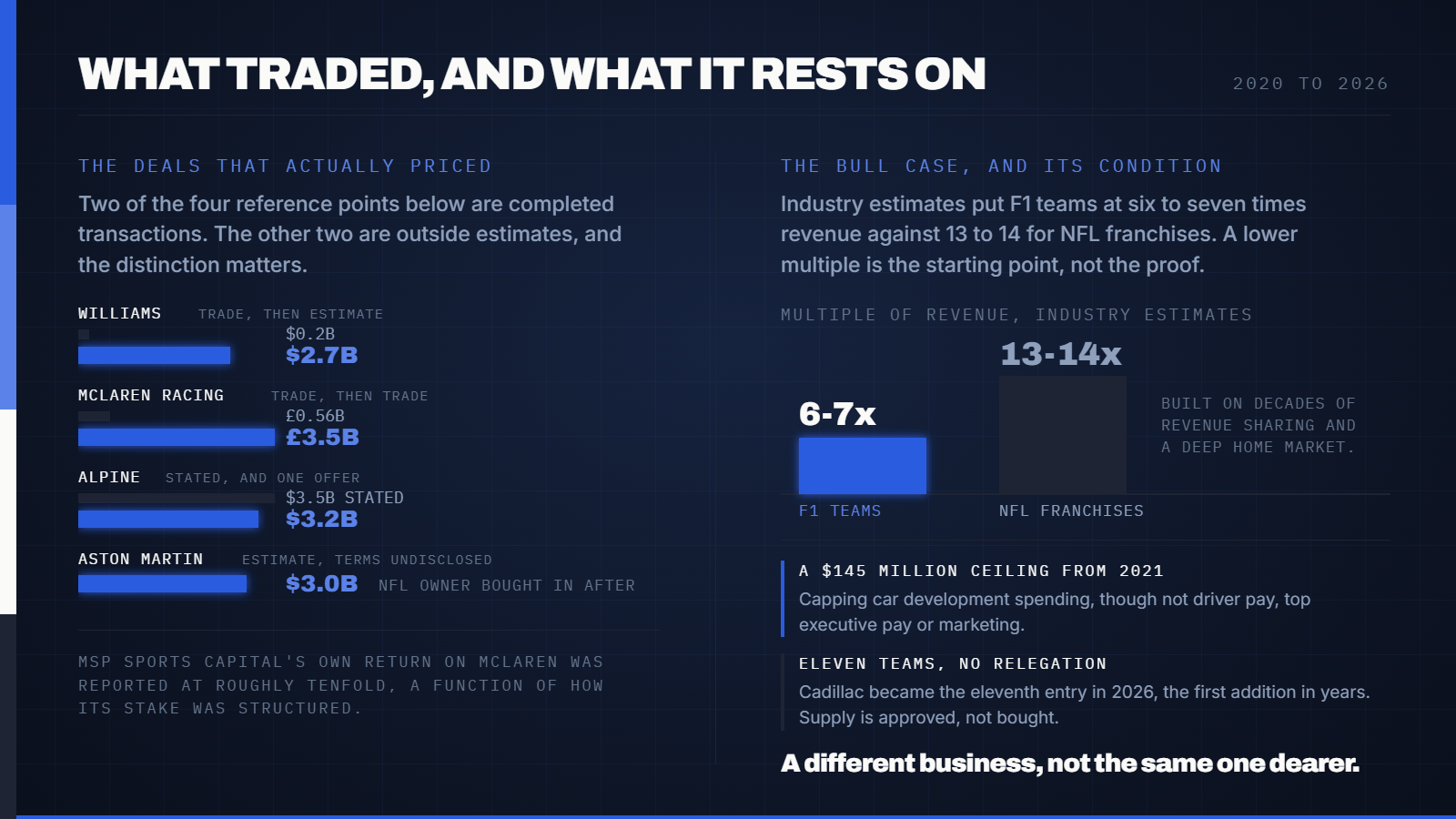
F1's 2021 financial regulations changed one of the central financial risks of owning a team: how much money could be spent chasing performance, with no ceiling before that year. The cost cap started at $145 million for 2021 and has moved with inflation and calendar length since, covering spending on car development and performance staff. It explicitly excludes driver salaries, the pay of a team's three highest-paid executives, marketing, and capital spending on property. The cap didn't make every team profitable overnight. What it did was put a ceiling around a major, previously uncapped part of the competitive spending race, at the same time F1's commercial revenue, sponsorship market, and audience were all expanding under Liberty Media's ownership. Controlled costs plus growing revenue is what made future team cash flows easier for investors to underwrite, not the cap by itself.
Williams co-owner Matthew Savage has described the industry-wide repricing this way: teams traded "at one times revenue" around the time Dorilton bought in, and now trade at "about seven times revenues," in his own words, a shift in how the market prices this kind of business generally rather than a claim about Williams' own current multiple specifically.
Grid Supply Is Tightly Controlled
Formula 1 has a structural feature that strengthens the scarcity case, though it isn't literally fixed: entry supply is tightly controlled. There's no promotion or relegation, and a prospective new team can't buy its way into the championship without going through F1 and FIA approval. Ten teams competed continuously through 2025 before Cadillac became the eleventh in 2026, the first new entry in years. Investors making the bull case for F1 valuations increasingly compare that controlled supply to the way major US leagues also restrict franchise expansion, even though those leagues field far more teams in absolute terms.
The Deals Behind the Numbers
McLaren Racing's ownership changes provide one of the clearest transaction-based examples. MSP Sports Capital and other minority investors bought into the group in 2020 at a valuation of roughly £560 million. Those stakes were bought out in September 2025 by Bahrain's Mumtalakat and Abu Dhabi's CYVN Holdings, in a deal reported at about £3.5 billion; people familiar with the transaction separately told reporters it represented roughly a tenfold return for MSP specifically, a figure tied to how MSP's own stake was structured rather than simple valuation growth. Aston Martin took in a minority investment from Woody Johnson, the New York Jets owner, in August 2026, on terms neither side disclosed; Sportico had valued the team at $3 billion the previous November. Johnson's own lack of a racing background matters less than what his investment signals: an established NFL owner treating an F1 team as the same kind of scarce sports asset worth adding to a portfolio, not as an extension of an automaker's marketing budget.
Briatore's Alpine Comparison Shows the Valuation Gap
Alpine's own team principal has offered the sharpest illustration of how differently sports and industrial assets get priced, and he's put three different numbers on the table in the same conversation. Flavio Briatore has said Alpine itself is working from a valuation around $3.5 billion, that a reported offer for a 24% stake in the team implied $3.2 billion, and that Alpine represents roughly 40% of Renault Group's stock-market capitalization, cited in the same interview at about $8.5 billion. The comparison to Renault isn't really like for like: Renault's market value reflects a capital-intensive global manufacturer exposed to auto-industry cycles, debt, and factories, while an F1 franchise is increasingly priced as a scarce media and sports asset with tightly controlled supply. Investors are applying two very different pricing frameworks to the racing team and the company that owns it, and the gap between those frameworks is what Briatore's comparison shows, not that either number is wrong.
The NFL Comparison Behind the Bull Case
Some investors and sports bankers point to a wide gap as evidence F1 valuations can keep climbing: recent industry estimates put F1 teams at roughly six to seven times revenue, against 13 to 14 times revenue for NFL franchises. That gap exists, but a lower multiple isn't proof of undervaluation on its own. NFL franchises benefit from decades of revenue-sharing, a deep domestic media market, and cash-flow predictability that F1 teams, several of which were losing money five years ago, haven't yet had time to demonstrate. The multiple gap is the bull case's starting point, not its proof.
The Pulse24 Take
The transformation since 2020 is bigger than the headline multiples suggest. Investors aren't simply paying more for the same F1 teams they'd have bought in 2020. They're pricing a different economic proposition: performance spending under a regulatory ceiling, a much larger commercial business under Liberty Media, and a grid with tightly controlled supply that doesn't expand on demand.
A six-to-seven-times-revenue multiple looks modest next to the NFL, but that comparison only means something if F1 can eventually offer the durability and predictable profitability the NFL has spent decades building. Whether F1 can close that gap matters far more than whether the next minority stake changes hands at another record headline valuation.
How we read the data
Curious how we get from raw data to a take like this? Our Trader's Toolkit walks through the tools we lean on.
Explore the Toolkit