Pulse24 Original
How the F1 Points System Works: Grand Prix and Sprint Points Explained
October 16, 2026
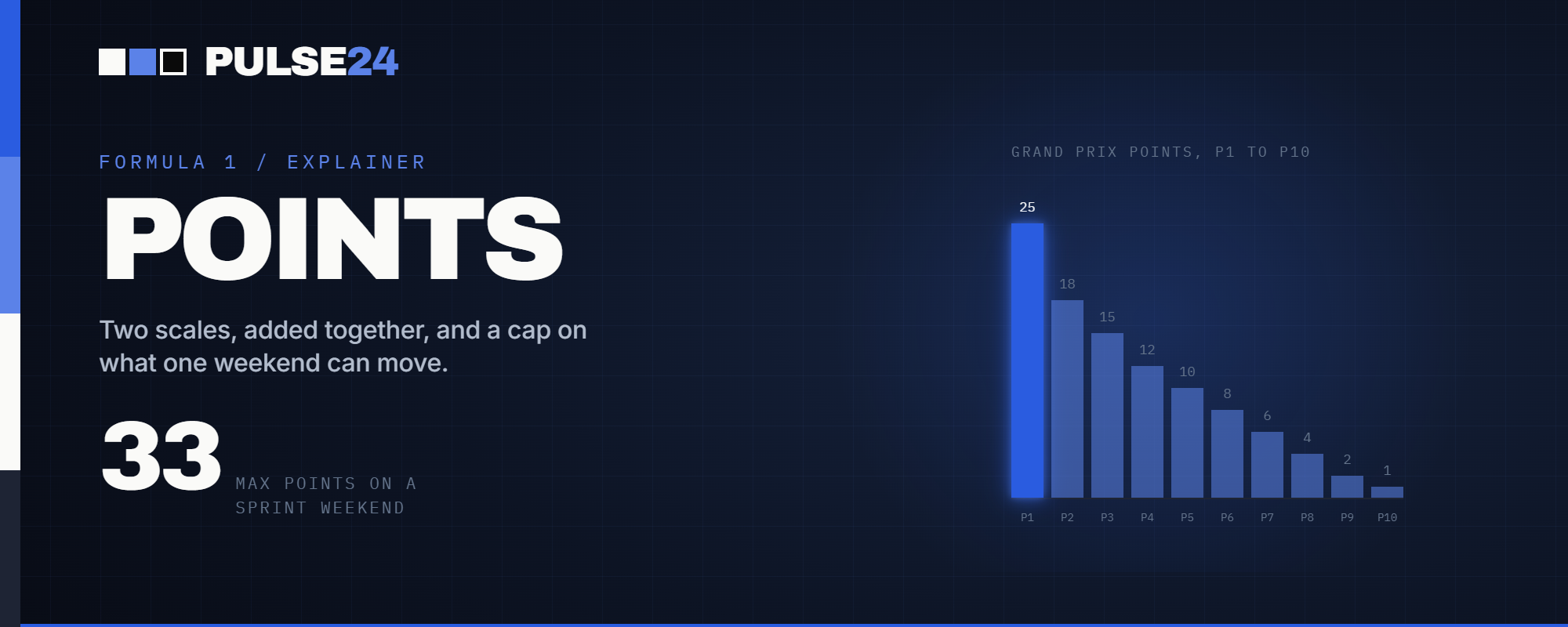
Formula 1 hands out points on two different scales, one for Sunday's Grand Prix and a smaller one for Saturday's sprint, and a shortened race pays a reduced scale of its own. With six races left in the 2026 season and the midfield packed into a 37-point span, knowing the real math actually matters.
Formula 1 awards points on two different scales depending on the day, and one easy mistake is to mix them up when doing standings math in your head. Heading into the final six rounds of 2026, second through sixth in the drivers' championship span just 37 points, a gap close enough that a single strong Grand Prix weekend could reorder several positions, even if it couldn't close the whole thing by itself.
Sunday's Grand Prix pays the top 10 finishers only, on a scale that drops fast near the front and levels off after that: 25 points for the win, 18 for second, 15 for third, then 12, 10, 8, 6, 4, 2, and 1 point for tenth. Finish 11th or worse and the race pays nothing at all, regardless of how competitive the car was that day.
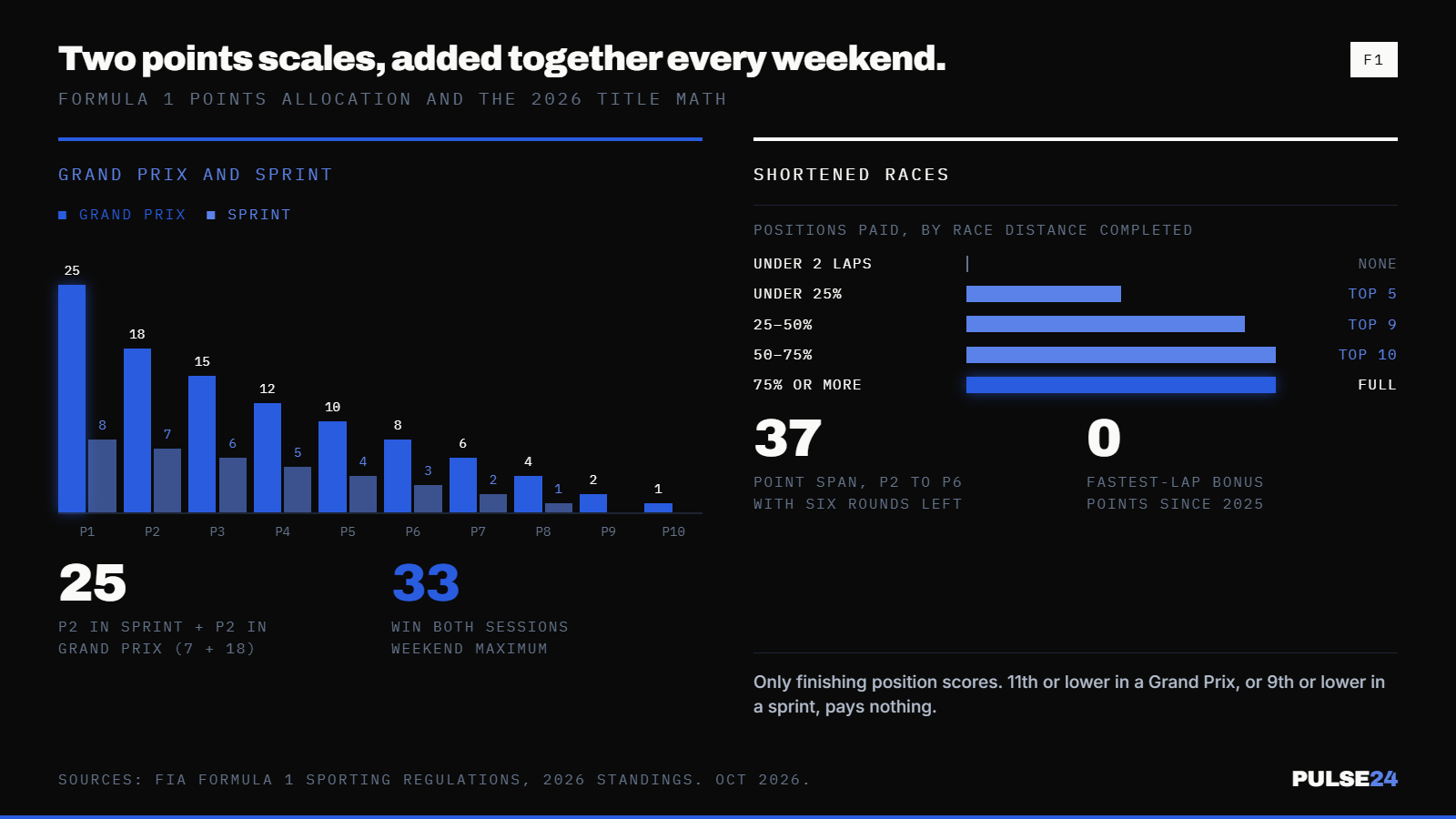
Saturday's sprint runs on a smaller, separate scale that only pays the top eight: 8 points for the win, down to 7, 6, 5, 4, 3, 2, and 1 for eighth. The two sessions don't interact with each other directly; a driver's sprint points and Grand Prix points from the same weekend simply add together in the championship table. Sprints make up a small fraction of F1's full-length calendar, which is part of why a sprint result rarely decides a title on its own.
A worked example makes the addition clearer. A driver who finishes second in Saturday's sprint and second in Sunday's Grand Prix earns 25 points for the weekend: 7 for the sprint plus 18 for the race. A driver who wins both sessions outright earns 33: 8 for the sprint plus 25 for the race. That 33-point ceiling on a sprint weekend, or 25 on a normal one, is also the practical limit on how much ground any driver can make up on a single rival in one weekend.
One rule worth flagging for anyone used to older seasons: F1 scrapped the fastest-lap bonus point starting with the 2025 season. Before that, the driver with the fastest lap in Sunday's race earned one extra point, but only if they finished in the top 10. From 2025 onward, finishing position alone decides who scores, on both Saturday and Sunday.
What Happens When a Race Is Shortened
Not every Grand Prix runs its full scheduled distance. When a race is stopped early, for weather or a red flag, F1's sporting regulations use a tiered scale based on how much of the race the leader completed: nothing if the leader managed fewer than two laps, a reduced scale paying the top five if the race covered under 25% of its distance, a wider scale paying the top nine between 25% and 50%, a scale paying the top 10 between 50% and 75%, and full points to the top 10 at 75% or beyond. It's a rule that matters more than people expect, since a handful of rain-shortened races over the years have handed out well under half the usual points on offer.
Why the Current Math Matters
George Russell, Lewis Hamilton, Max Verstappen, Charles Leclerc, and Lando Norris are separated by just 37 points from second through sixth in the standings, with six rounds remaining. That's close enough for a strong weekend, worth a maximum of 25 points on a normal weekend or 33 with a sprint attached, to change the order significantly. It would still take more than one weekend for any of them to erase the entire gap from top to bottom in one go. McLaren's run of contact between its own two drivers this season is a reminder of how quickly a few points-less weekends can drop a driver from title contention to also-ran, even in a fast car.
A Brief History
The current 25-18-15-12-10-8-6-4-2-1 scale dates back to 2010, when F1 expanded scoring from the top eight finishers to the top ten to reward a bigger grid. Before that, from 2003 to 2009, the top eight scored on a 10-8-6-5-4-3-2-1 scale, and before that, only the top six scored at all. Sprint races, and their separate points scale, arrived in 2021 as a way to add a second competitive session to race weekends without touching the main event's scoring.
The Pulse24 Take
Break it into its parts and none of this is complicated: a Sunday finish pays roughly three times what a Saturday sprint does, a shortened race can hand out far less than the usual total, and the fastest-lap bonus that used to add a wrinkle to all of this hasn't existed since 2025. In a season where the championship's middle is this congested, those details decide who's still mathematically alive heading into the final flyaway rounds.
How we read the data
Curious how we get from raw data to a take like this? Our Trader's Toolkit walks through the tools we lean on.
Explore the Toolkit