Pulse24 Original
Demon Slayer: Infinity Castle Grossed $793 Million and Broke a 25-Year-Old Box Office Record. Anime Is Turning Into Sony's Best Growth Story.
August 7, 2026
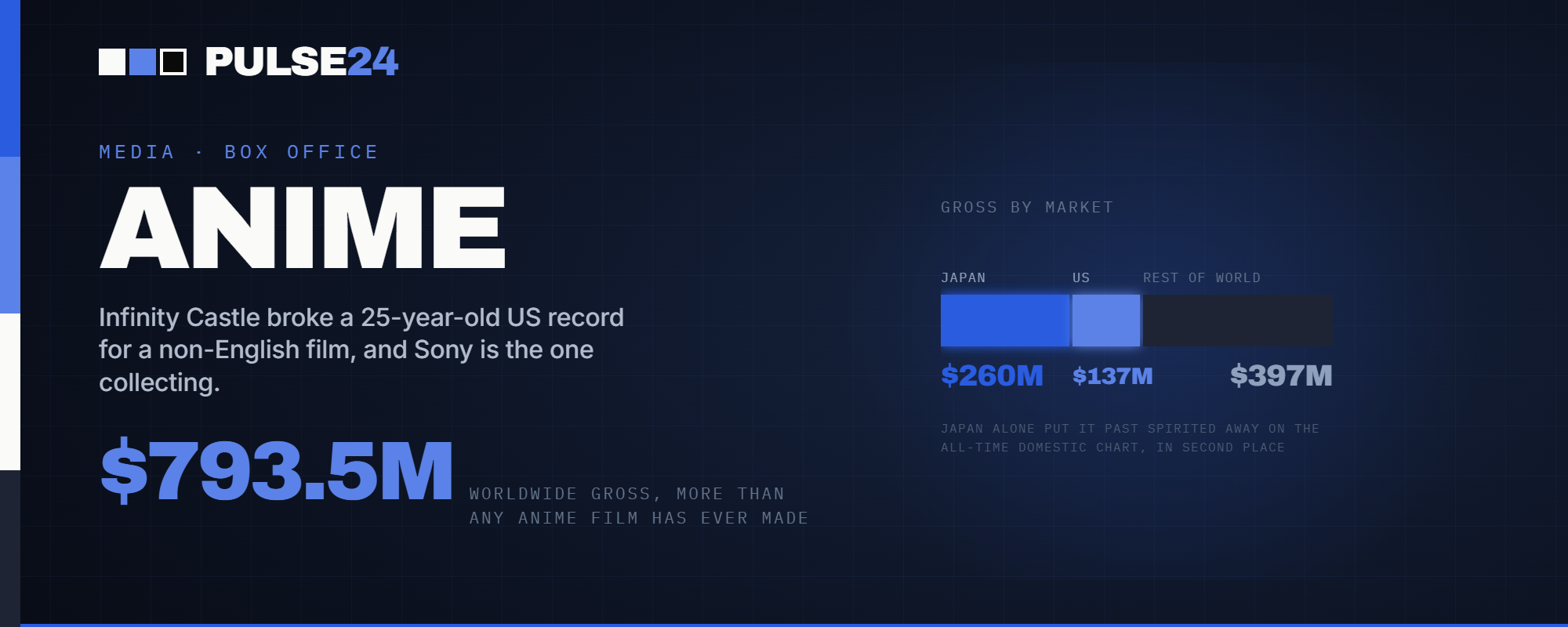
Demon Slayer: Infinity Castle just became the highest-grossing non-English film in US box office history and the highest-grossing anime film ever. Sony's own numbers show anime quietly turning into a real profit engine, and most financial coverage still hasn't caught up.
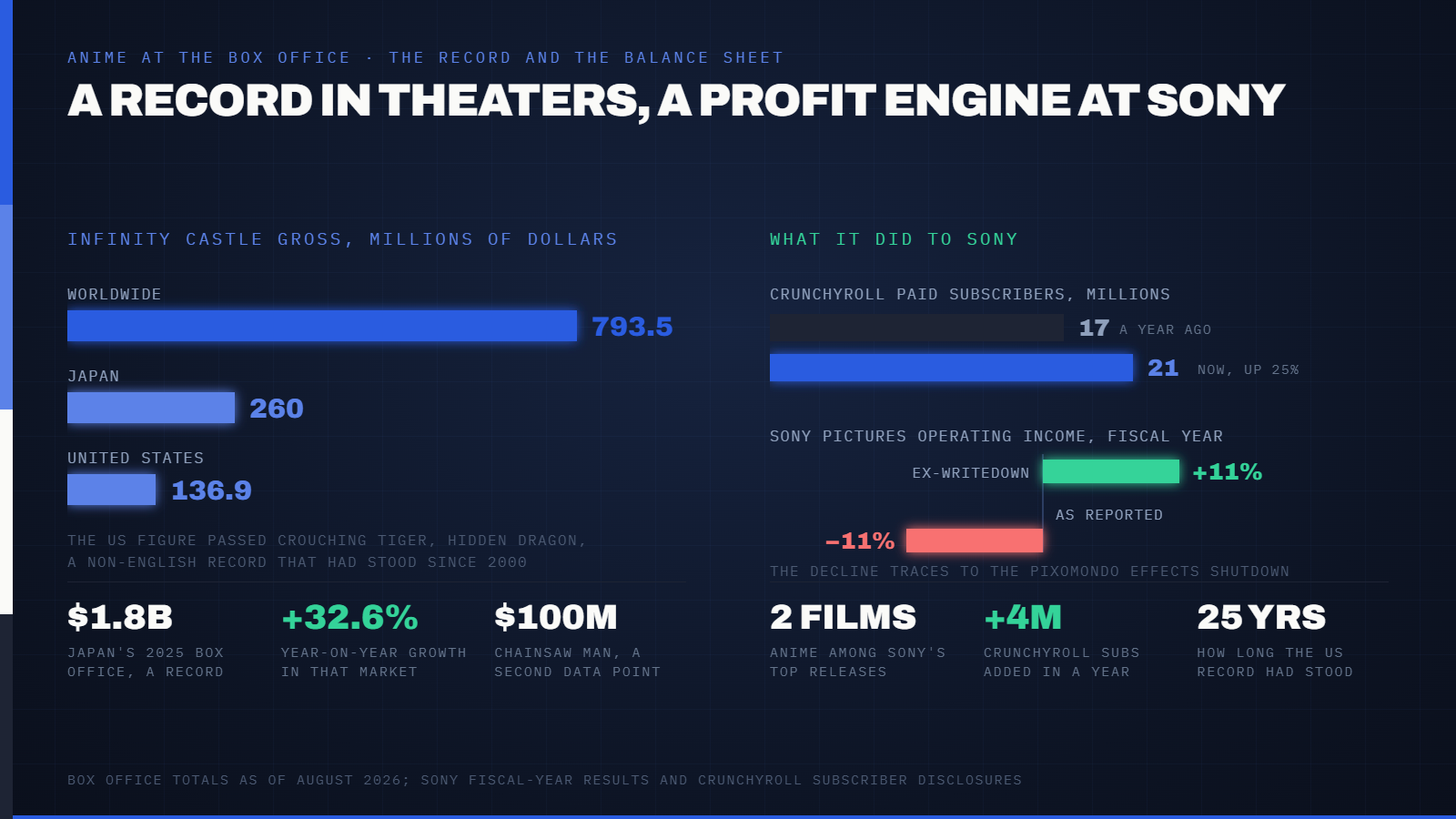
A Japanese anime film just broke a box office record that stood for 25 years. Demon Slayer: Infinity Castle earned $136.9 million at the US box office, more than Crouching Tiger, Hidden Dragon made in 2000, making it the highest-grossing non-English-language film in American box office history. Worldwide, it has taken in $793.5 million, more than any anime release has ever made, and in Japan it pulled in close to $260 million on its own, enough to knock Spirited Away out of second place on the all-time domestic chart.
None of that reads like a niche fandom story anymore. It reads like a business story that most financial coverage still hasn't caught up to.
What Changed
Anime has always sold well on streaming and in specialty screenings. What changed in 2025 is that it started competing directly with mainstream Hollywood releases for the same multiplex screens and the same opening-weekend headlines, and winning. Demon Slayer: Infinity Castle wasn't a limited-release curiosity. It played wide, sold out premium formats, and held its audience for months rather than fading after opening weekend the way most anime theatrical runs historically have.
Japan's own box office backs up that this wasn't a one-film fluke. The country's total 2025 theatrical revenue hit $1.8 billion, its best year on record and up 32.6% from 2024, with Demon Slayer and the live-action drama Kokuho, itself the highest-grossing Japanese-language film in the country's history, doing most of the lifting. Chainsaw Man: The Movie, Reze Arc added a second data point outside Japan, crossing $100 million worldwide and landing among the five highest-grossing anime releases in US history in its own right. One massive anime hit is an outlier. Two major franchises clearing records in the same year, in two different territories, is a trend.
Why It Matters
Sony is the company best positioned to benefit, and its own numbers show it. The studio's fiscal year results credited Demon Slayer and Chainsaw Man among its top theatrical performers, and Crunchyroll, Sony's anime streaming arm, grew to 21 million paid subscribers, up from 17 million a year earlier, a 25% jump. Sony Pictures' overall operating income fell 11% for the fiscal year, which on its own sounds like bad news, but the decline traces almost entirely to an impairment charge from shutting down its Pixomondo visual-effects unit. Strip that one-time item out and Sony Pictures' profit actually climbed 11%, with anime doing real work to get it there.
The economics behind that growth are different from a typical Hollywood release, which is part of why the business press has been slow to cover it with the same rigor it applies to a Marvel opening weekend. Anime films are usually windowed as short, high-intensity theatrical events tied closely to a manga or streaming fanbase that already exists, rather than built from a marketing campaign designed to create demand from nothing. That keeps the cost of getting people into a seat much lower relative to the box office it can pull in, which is a meaningfully different margin profile than a $200 million tentpole needs to work.
It's not all upside, and the numbers show that too. Crunchyroll's Japan-specific arm reported a 63% drop in net profit even as its global subscriber base grew, a reminder that subscriber growth and profit growth aren't the same line item, and that scaling a streaming service internationally costs real money before it pays off. The anime box office boom is real. Whether every part of the business built around it is scaling as cleanly is a separate, less settled question.
What to Watch Next
The obvious question is whether 2025 was a peak or a floor. Jujutsu Kaisen is the franchise most often cited as the next one capable of challenging Demon Slayer's numbers, built around a climactic storyline, Gojo versus Sukuna, that the manga and anime community has anticipated for years, though no studio has confirmed a theatrical adaptation or release date for it yet. Sony's next fiscal year results will show whether Crunchyroll's subscriber growth starts translating into profit the way the theatrical side already has, and whether last year's box office records get treated as the new baseline or as a single extraordinary year built around one exceptional film.
The Pulse24 Take
A film that most American audiences outside anime fandom couldn't name broke a box office record that had survived since Ang Lee's Crouching Tiger, Hidden Dragon, and it did it while barely registering in mainstream financial coverage. That gap is the actual story. Sony is disclosing real numbers, real subscriber growth, real theatrical performance, that show anime shifting from a streaming footnote to a genuine profit center, and most of the analysis treating it as a business trend rather than a fan phenomenon is coming from anime trade press rather than the outlets that usually cover a studio's earnings. Markets tend to be slow to reprice a business line that doesn't fit the categories analysts already track. Anime at Sony looks like exactly that kind of blind spot right now, growing fast, showing up in the numbers, and still being covered like a curiosity instead of a business.
How we read the data
Curious how we get from raw data to a take like this? Our Trader's Toolkit walks through the tools we lean on.
Explore the Toolkit