Pulse24 Original
Two Days From No Thor At All: How Chris Hemsworth Built Marvel's Longest-Running Career on a Role He Almost Didn't Get
August 11, 2026
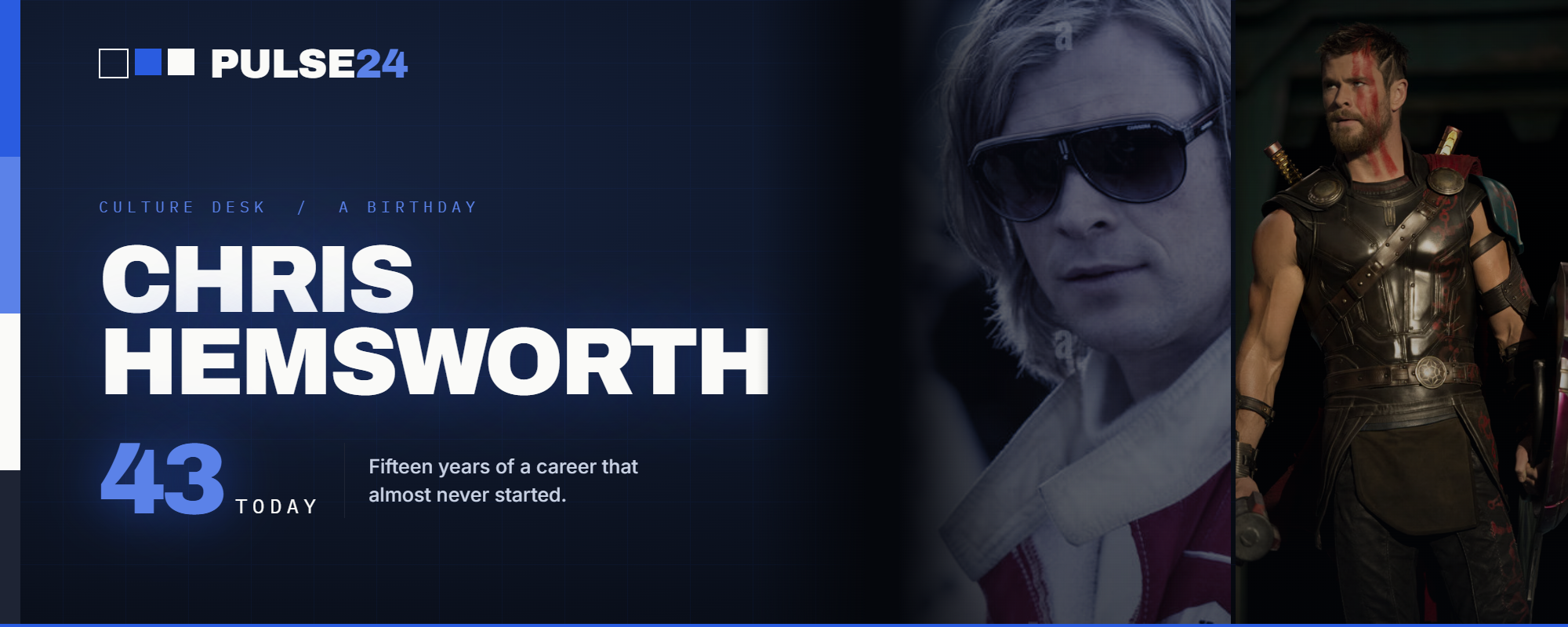
Chris Hemsworth turns 43 today, fifteen years into a career that nearly didn't happen: a soap opera stigma, a reality dance show that almost cost him Thor, and a box office bomb cast two days before it. In between, a genetic test result changed how he thinks about all of it.
Two days. That's how long separated Chris Hemsworth from Red Dawn, a remake so troubled it grossed just $50 million against a $65 million budget, and Thor, the role that would make him one of the highest-paid actors alive.
He turns 43 today.
The fifteen years in between weren't a straight climb. They included a soap opera stigma Marvel almost couldn't see past, a reality dance competition that nearly cost him the role outright, at least four outright bombs, one instance of Hemsworth publicly agreeing his own movie wasn't very good, and a blood test partway through that told him he's eight to ten times more likely than most people to develop Alzheimer's disease.
How Close This Came to Not Happening
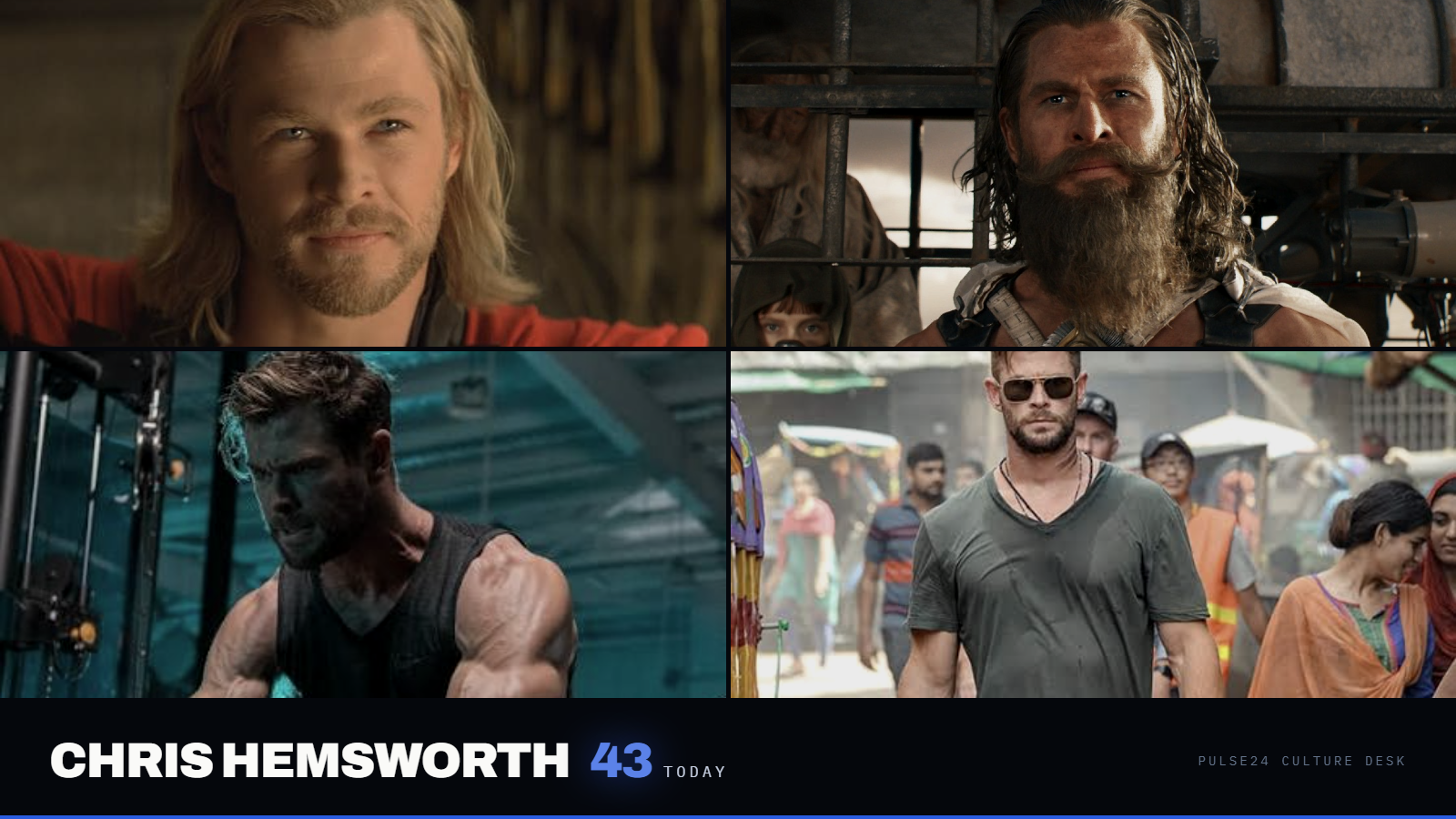
Start in Melbourne, then Bulman in the Northern Territory, where Hemsworth grew up the middle of three brothers who would all become actors. The industry's first real look at him was Home and Away, 171 episodes as Kim Hyde between 2004 and 2007. He's been candid since that the role bought him nothing in Hollywood credibility. "Soap actor" was a label, not a stepping stone, and it followed him for years.
It nearly followed him out of a career entirely. In 2006 he competed on Dancing with the Stars Australia, partnered with Abbey Ross, and was eliminated after six weeks. When Marvel started circling him for Thor, producers reportedly worried the show would undercut the god-of-thunder gravitas they needed audiences to buy. A reality dance competition almost cost him the role that made him a movie star.
Star Trek got him to Hollywood first, in 2009, in a part J.J. Abrams had originally offered to Matt Damon. Hemsworth played George Kirk, James T. Kirk's father, and he's only on screen for the film's opening minutes before the character dies saving his crew. One critic called it the best five minutes he'd spent in a movie theater that year. It was a tiny role that did an outsized amount of work introducing him to American audiences.
Then came the two-day gap. Hemsworth was cast in Red Dawn, MGM having seen his dailies from the then-unreleased Cabin in the Woods and liked what it saw. Two days later, he was cast as Thor instead, after gaining twenty pounds of muscle for the audition and beating out Tom Hiddleston, who'd go on to play Loki instead. Red Dawn wouldn't come out for another three years, and by the time it did, quietly, to a $50 million gross, Hemsworth was already the biggest new face in the Marvel Cinematic Universe. Thor opened in 2011 to $449.3 million worldwide, and the actor nobody in Hollywood had taken seriously a year earlier was suddenly impossible to ignore.
Fifteen Years, One Hammer, and Everything Built Around It
The Avengers ensemble is where the real numbers live. The Avengers made $1.519 billion in 2012. Age of Ultron made $1.403 billion in 2015. Infinity War made $2.048 billion in 2018. Endgame made $2.798 billion in 2019, the second-highest total any film has ever earned. Hemsworth's own solo Thor films tell a bumpier story: Thor: The Dark World became, at 66% on Rotten Tomatoes, the lowest-rated entry in the MCU at the time it released, while Thor: Ragnarok, reoriented entirely around Taika Waititi's comic instincts, became the best reviewed of the four and pulled in $854 million worldwide.
The paychecks tracked the character's rise almost exactly. Hemsworth made a reported $150,000 for the first Thor. By Endgame, his base salary plus profit participation reportedly totaled around $76.4 million. Avengers: Doomsday, due this December, is estimated in the $25 to $30 million range on its own. Few actors have a pay stub history that doubles as a chart of a franchise's box office ambitions.
Marvel wasn't the only proof of range. Rush, Ron Howard's 2013 film about the Niki Lauda-James Hunt Formula 1 rivalry, remains Hemsworth's most critically vindicated work outside the franchise, holding at 88% with both critics and audiences on Rotten Tomatoes and giving him a role built on ego and recklessness rather than heroism. It's the film most often cited when people argue he can do more than swing a hammer.
Not everything landed, and Hemsworth has rarely pretended otherwise. He's said flatly that he didn't enjoy his own performance in Blackhat, calling it flat. He's been just as candid about Thor: Love and Thunder, saying the film "became too silly" and that he didn't stick the landing, turning the character into something close to a parody of himself. Between those admissions sit a run of films that split critics and audiences almost evenly: Ghostbusters (2016), where Hemsworth personally got some of the only praise in an otherwise polarizing reboot, and Men in Black: International (2019), a $253.9 million worldwide earner that mostly disappointed critics despite his chemistry with Tessa Thompson.
Streaming gave him a second engine entirely. Extraction, Netflix's 2020 action thriller reuniting him with the Russo brothers, was watched by 90 million households in its first month, breaking a viewership record Bird Box had held. A sequel followed in 2023, and a third is already in the works.
The Test That Changed the Frame
Furiosa: A Mad Max Saga is the film that best captures where Hemsworth's career sat heading into this birthday. Cast as the warlord Dementus, he got a six-minute standing ovation at its Cannes premiere and reviews that ranked among the best of his career. The Washington Post called Dementus one of the all-time great screen villains. He earned an AACTA nomination for it. And the film still grossed just $174.4 million worldwide against a $168 million budget, a result so far below expectations that Warner Bros. reportedly lost close to $120 million on it once every cost was counted. Critical acclaim and box office success stopped being the same conversation, and Hemsworth ended up on the wrong end of that split despite doing some of his best work.
That split happened around the same stretch of years he learned something that reframed how he thought about work at all. Filming the National Geographic series Limitless in 2022, Hemsworth took a genetic test as part of an episode about longevity and discovered he carries two copies of the APOE4 gene, a configuration found in only two to three percent of the population. It made him eight to ten times more likely than average to develop Alzheimer's disease, the same illness that had already taken his maternal grandfather. He's said the result rattled him enough that he seriously considered stepping back from acting altogether.
He didn't step back, not permanently. What changed was closer to a recalibration. He returned to the Alzheimer's subject directly in 2025's A Road Trip to Remember, a documentary built around his own father's experience with the disease, trading the extreme-adventure framing of Limitless for something quieter and more personal. Taken together with Furiosa, a role he chased for its difficulty rather than its safety right around the time he got that test result back, the picture that emerges isn't a man retreating from risk. It's someone who found out how much time might actually be finite and decided that was a reason to keep choosing harder parts, not easier ones.
What Comes Next
Avengers: Doomsday arrives December 18, and it puts Hemsworth's Thor across from Robert Downey Jr., who spent the franchise's first decade as Iron Man and now returns as Doctor Doom, the villain. It's a strange, fitting bit of symmetry: the actor who helped open the MCU now facing off, fifteen years later, against the actor who built it, on opposite sides. Extraction 3 is in development. He's in talks to play the title role in Disney's Prince Charming. A Transformers and G.I. Joe crossover and an Apple sci-fi project are both somewhere on the runway. None of it reads like a career winding down.
The Reframe
It would be easy to tell this story as a straight line: soap actor becomes movie star, movie star becomes billionaire franchise's most bankable face. That's not really what happened. What happened is closer to a series of near-misses that landed anyway, a dance show that almost cost him everything, a tiny role that got him noticed, a blockbuster bomb that preceded the role of a lifetime by 48 hours, and, later, a piece of genetic information that could have made anyone walk away entirely.
He didn't. He took the villain role that terrified him and got a standing ovation for it, even after the box office didn't cooperate. He made a documentary about the exact disease his own test results flagged, rather than avoiding the subject. Forty-three isn't a milestone birthday in the way thirty or fifty are. But measured against how close the whole thing came to not happening at all, every year since has been the part nobody was guaranteed.
How we read the data
Curious how we get from raw data to a take like this? Our Trader's Toolkit walks through the tools we lean on.
Explore the Toolkit