Pulse24 Original
Chip Stocks Fell for a Seventh Straight Session. The Dow Still Rose 556 Points.
October 16, 2026
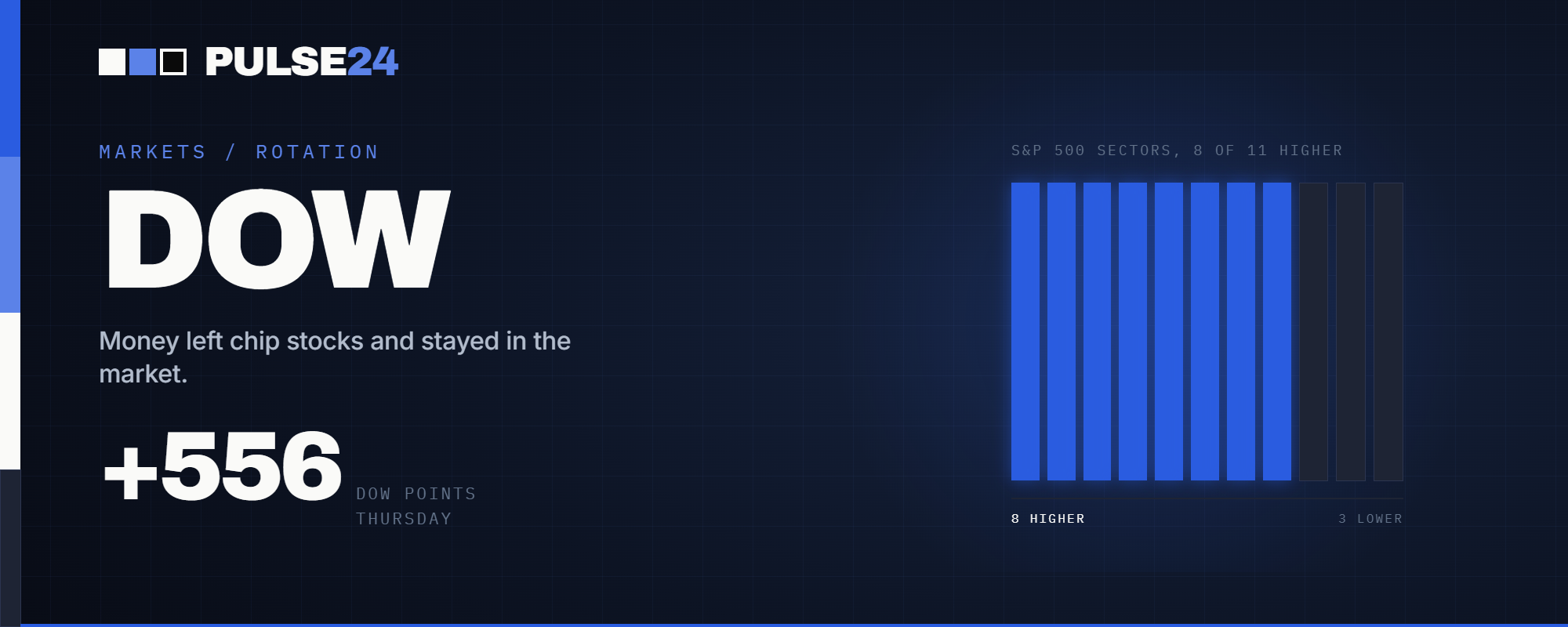
Chip stocks fell for a seventh straight session Thursday, but the Dow still gained 556 points as money rotated into healthcare, financials and consumer names. Treasury yields dropped the most in over a year, even as hot inflation data pushed December rate hike odds higher.
The Dow Jones Industrial Average closed at 52,177.69 Thursday, up 556.21 points, or 1.08%, one of its stronger sessions this month. Almost none of that strength came from the sector that built this year's rally.
Chip stocks kept falling. The Philadelphia Semiconductor Index dropped 103.17 points, or 0.88%, to 11,581.22, its seventh consecutive losing session, extending this week's broader slide in chip stocks. Nvidia fell 1.84%. Intel dropped 2.80%. Dell lost 6.8%, and Hewlett Packard Enterprise fell 7.1%. Taiwan Semiconductor's ADR slipped 1.80% to $422.25, extending a pullback that started even after the company posted a record quarter.
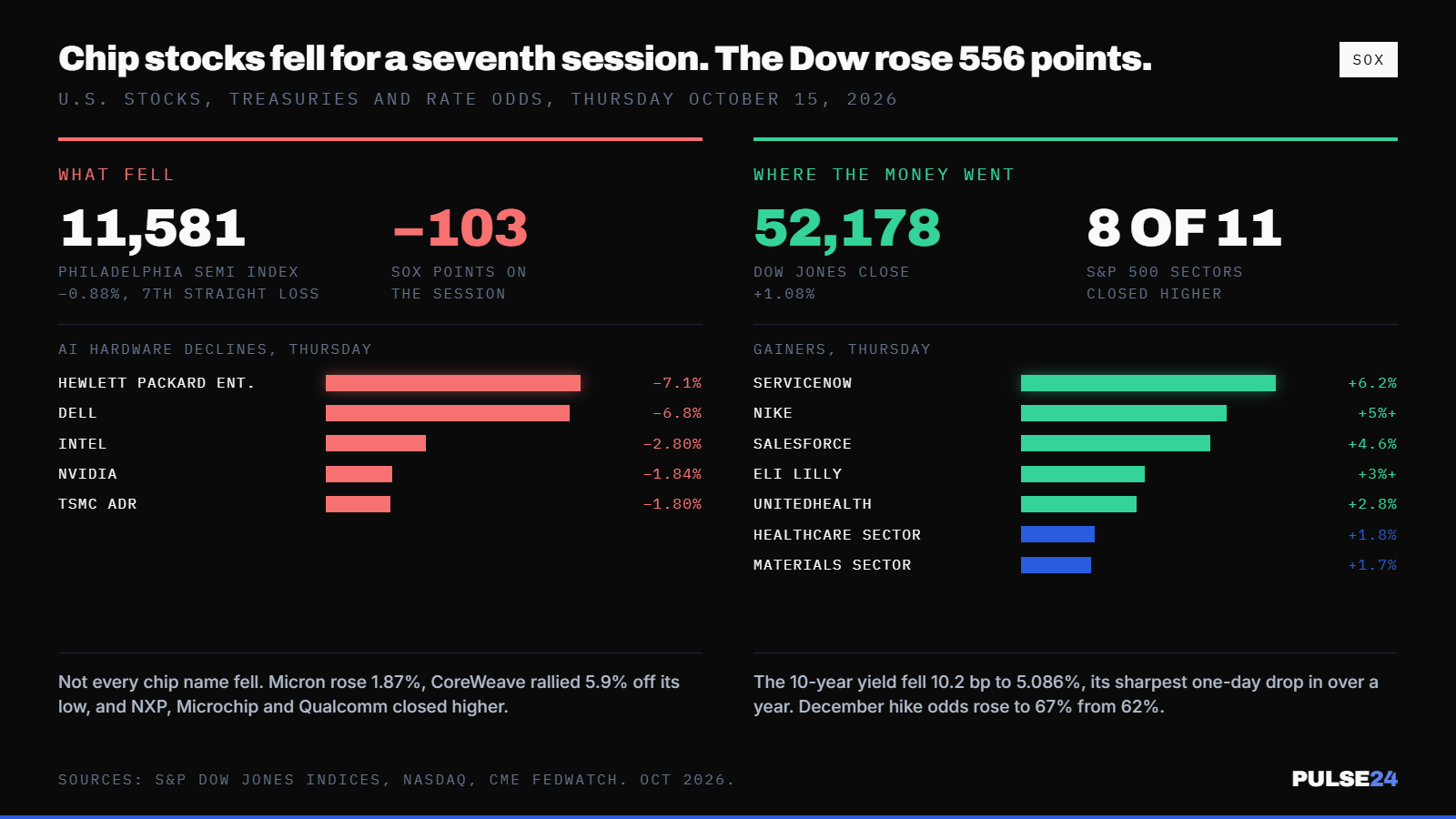
The money didn't leave the stock market. It moved. Eight of the S&P 500's 11 sectors closed higher Thursday, led by healthcare, up 1.8%, and materials, up 1.7%. Eli Lilly climbed more than 3% as investors rotated out of chip stocks and into healthcare names. UnitedHealth added 2.8%. Walmart gained 1.4%, and Nike rose more than 5%. Even inside software, a group that often trades alongside the chip names, ServiceNow jumped 6.2%, Salesforce rose 4.6%, and Microsoft added 1.1%.
Not every chip name fell. CoreWeave rallied 5.9% off its intraday low, a notable bounce for a stock whose credit-default swaps hit a record high on default-risk concerns earlier this week. Micron gained 1.87%. NXP, Microchip, and Qualcomm all closed higher too. The split wasn't semiconductors versus everything else. It ran narrower, between the AI-infrastructure names carrying the heaviest debt and spending commitments, and nearly everything else.
Why It Matters
That doesn't follow the usual script. Hot inflation data is supposed to push bond yields higher, not lower. September's producer price index rose 1.3% month over month, well above the 0.6% economists expected, and 6.3% year over year, the hottest reading since 2022. Yet the 10-year Treasury yield fell 10.2 basis points to 5.086%, and the 30-year fell 9.7 basis points to 5.427%, both the sharpest single-day declines in more than a year.
Two things can explain that. One is a flight to quality that has less to do with inflation than with chip-sector stress: when a sector loaded with AI-infrastructure debt starts wobbling, investors often buy long bonds regardless of what inflation is doing, because the bigger worry becomes a broader growth scare. The other is that the bond market may be reading the Fed's reaction function differently than the futures market is. Evercore's Krishna Guha argued this week that tech volatility and tightening financial conditions could make Fed Chair Kevin Warsh reluctant to signal an October hike, even with inflation running hot.
The futures market didn't fully buy that caution. The CME FedWatch Tool put the odds of a December rate hike at 67% after Thursday's data, up from 62% the day before. So the market raised the odds of a hike while simultaneously bidding up the bonds a hike would normally hurt. Investors don't need to resolve that tension today, but it does suggest conviction is thin in both directions.
What to Watch Next
Two threads are worth following. The first is whether the chip-sector slide reflects a genuine capex reassessment or just a pause after a long run, something that should become clearer as more AI-infrastructure names report earnings in the coming weeks. The second is the labor market. Retail sales rose a surprising 0.8% in September against a 0.3% forecast, but Thursday's company-specific numbers told a mixed story: Charles Schwab fell about 3% despite record revenue, after that revenue narrowly missed analyst estimates, and ManpowerGroup, a staffing firm whose results are often read as an early hiring signal, dropped roughly 16% on a revenue miss paired with news of a CEO transition.
None of this resolves in a single session. The Fed's next meeting is roughly two weeks away. Between now and then, both the rotation out of chip stocks and the rally in long bonds will either firm up into a trend or fade as a one-day anomaly.
The Pulse24 Take
One strong session doesn't make a new regime. Chip stocks have had rough stretches before and recovered; a seven-day slide doesn't by itself invalidate the AI buildout thesis that's driven markets most of this year. What's worth watching is whether the rotation into healthcare, materials, and value holds up once the next round of earnings lands, and whether bond yields keep falling even if the Fed sounds more hawkish at its next meeting. If both of those things are still true in two weeks, that's a more meaningful signal than one Thursday where the Dow outran the Nasdaq.
How we read the data
Curious how we get from raw data to a take like this? Our Trader's Toolkit walks through the tools we lean on.
Explore the Toolkit