Pulse24 Original
Alcoa's Net Income Doubled to $483 Million. A Decade-Idle Smelter Was the Quarter's Bigger Story.
October 16, 2026
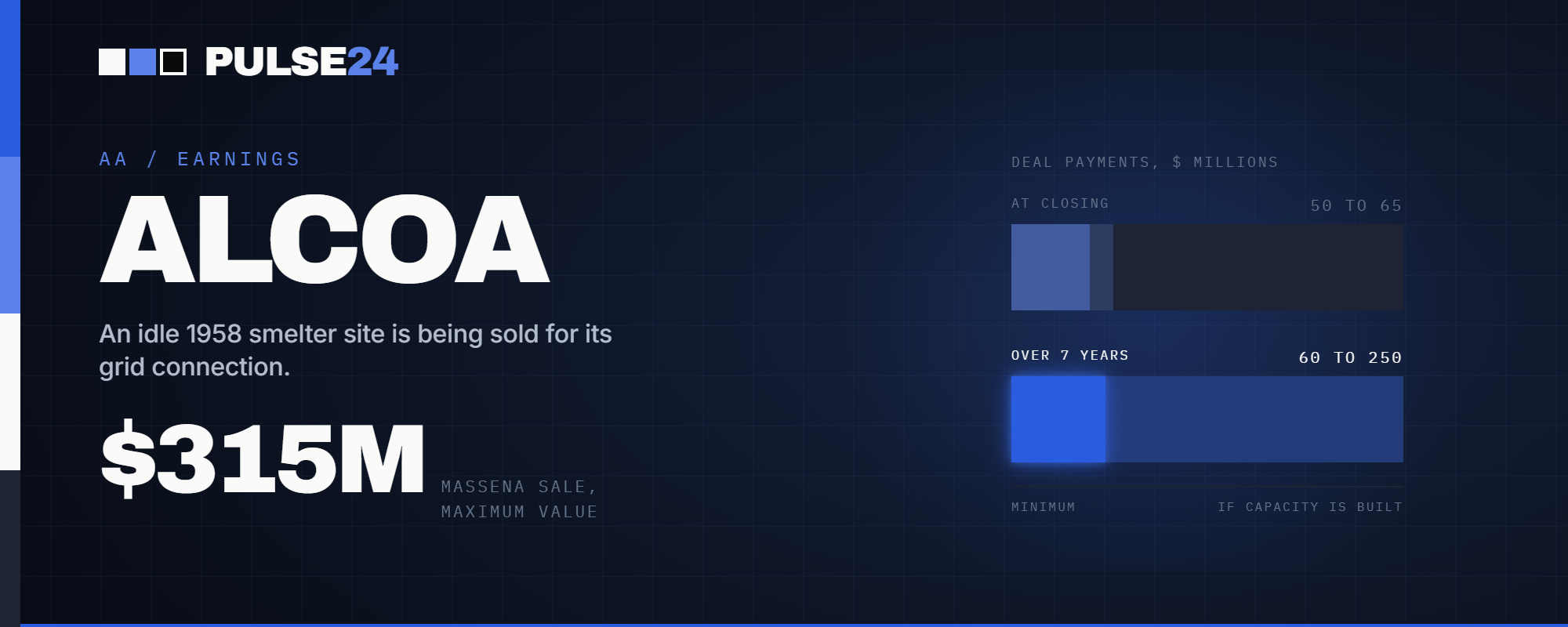
Alcoa's third-quarter net income rose to $483 million from $232 million a year ago, helped mainly by mark-to-market gains and lower costs, not higher aluminum prices, which actually slipped from the second quarter. The same report disclosed something arguably more interesting: a not-yet-closed agreement to sell part of its idled Massena smelter site in upstate New York for AI and crypto data center use, worth up to $315 million over the next seven years.
Alcoa's net income came in at $483 million for the third quarter. A year ago, the same quarter produced $232 million. That's more than double, on a quarter where the company's core product actually got a little cheaper.
Revenue told a more mixed story. It rose 24% from a year ago to $3.7 billion, but slipped 7% from the second quarter as both aluminum shipments and the price Alcoa realized for its metal came down. The company sold aluminum for $4,527 a metric ton in the quarter, below the $4,752 it got in the second quarter, though still well above the $3,374 a ton it was fetching a year ago. Alcoa itself credited most of the profit jump to mark-to-market gains on its stake in the Saudi joint venture Ma'aden, gains on energy contracts, and lower production costs, not to stronger aluminum markets.
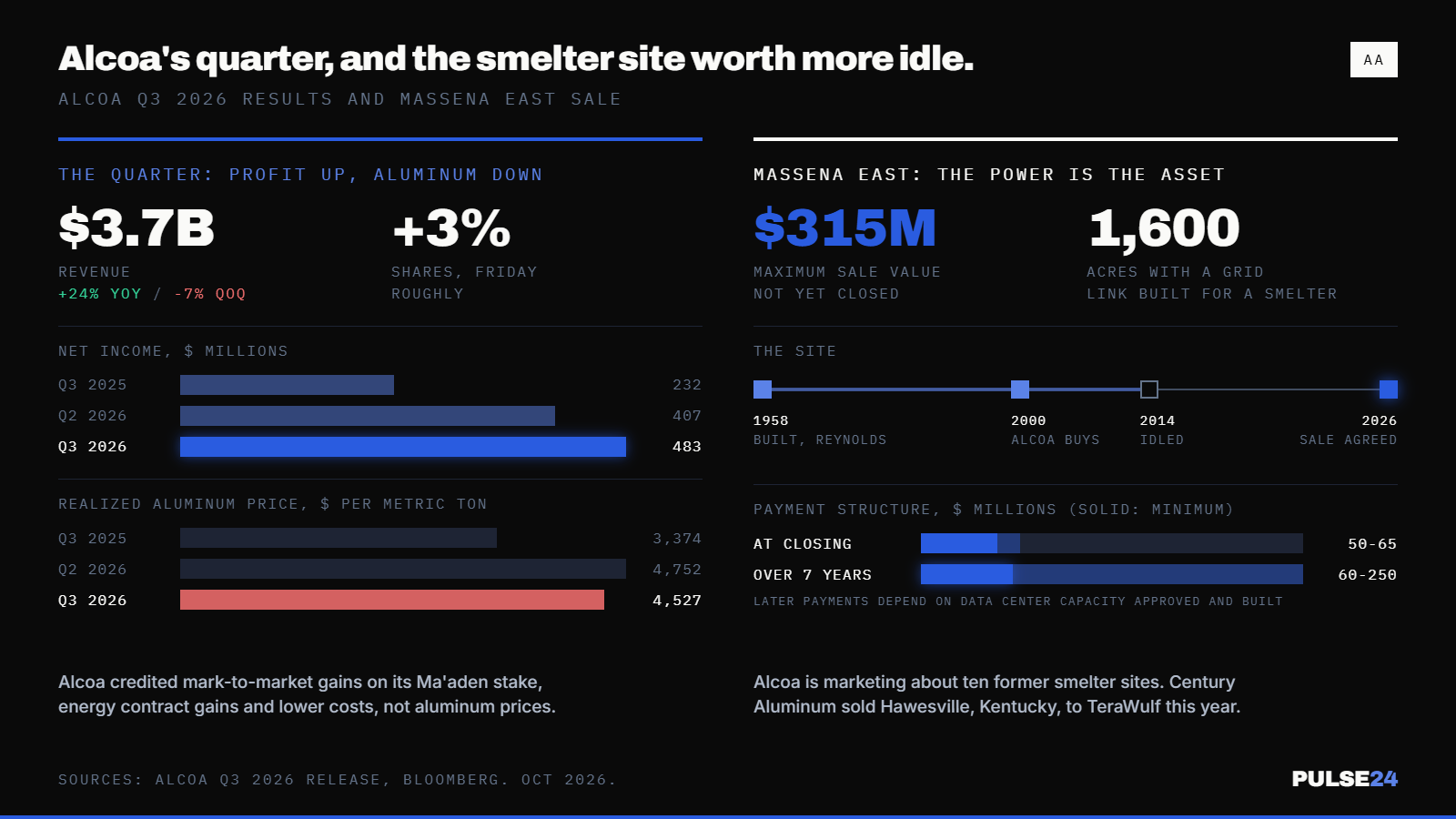
Buried in the same release was a disclosure that has nothing to do with any of that. Alcoa said it entered into definitive agreements to sell portions of its Massena East site, an idle smelter in upstate New York, to a buyer developing data center capacity there. The deal is structured in pieces: $50 million to $65 million at closing, which Alcoa expects within six months pending permits and regulatory approval, plus another $60 million to $250 million over the following seven years tied to how much data center capacity actually gets approved and built. Add it up and the total reaches as much as $315 million, none of which has hit Alcoa's income statement yet. The arrangement lines up with reports dating back to April, when Bloomberg reported Alcoa was in advanced talks to sell the site to NYDIG, a Bitcoin mining firm, with CEO Bill Oplinger saying at the time that a deal should close around the middle of the year.
A Smelter Built for Power, Not Aluminum
Massena East wasn't always idle. Alcoa's predecessor built the smelter in 1958 as the Reynolds Metals Facility, and Alcoa inherited it when it bought Reynolds in 2000. For more than half a century it ran on something aluminum smelting has always needed in huge quantities: cheap, reliable electricity, delivered in this case as hydropower through the New York Power Authority. When high energy costs and cheaper overseas competition made the smelter uneconomic in 2014, Alcoa shut it down. Aluminum production stopped there and then. What didn't go anywhere was 1,600 acres of land and a grid connection built to handle an entire smelter's appetite for power.
That connection is now worth more than the smelter it fed. Large, pre-approved electricity loads are exactly what data center and Bitcoin mining operators are short of right now, and new interconnection requests can take years to work through. A site that already has the wires, the substations, and the power contracts skips most of that line. Alcoa isn't the only aluminum producer discovering this. Century Aluminum sold its Hawesville, Kentucky smelter to Bitcoin miner TeraWulf earlier this year, and TPG Real Estate is building a gigawatt-scale data center campus on a former Alcoa smelting site in Adamstown, Maryland. Alcoa itself has said it's marketing roughly ten former smelter sites across the US to exactly this kind of buyer.
Why It Matters
Pulse24 has written before about how data center demand is straining the US power grid from the generation side, pushing up wholesale electricity prices well ahead of anything data centers themselves are paying for. The Alcoa deal shows the same pressure working from a different angle: on the value of land that already has power attached to it. An idled 1958 smelter that earned nothing for over a decade just became a line item worth up to $315 million, not because anyone found a better way to make aluminum there, but because the thing sitting next to the aluminum business, a grid connection built for an entirely different era of industrial demand, turned out to be the asset everyone wants. That this shows up in the same release as a near-doubling of net income is a coincidence of timing, not cause and effect, but it's a useful coincidence. It puts an actual dollar figure on something usually described only in vague terms, like strategic value or optionality.
It also blurs a line Pulse24 readers have seen drawn before, between AI infrastructure spending and Bitcoin mining. Both need the same scarce input: megawatts, delivered reliably, at a site that can get built fast. NYDIG's reported interest in Massena isn't really a bet on aluminum, or even directly on AI. It's a bet that whoever controls hard-to-replace power capacity can rent it to whichever buyer, a hyperscaler or a Bitcoin miner, is willing to pay the most for it in a given year.
What to Watch Next
Alcoa's own aluminum business still faces a choppier near term. The company's guidance points to roughly $30 million of headwinds next quarter from raw materials and planned maintenance, plus another $30 million from higher alumina costs, even as it expects both production and shipments to rise. Watch whether Alcoa closes more of the other nine or so former smelter sites in the coming quarters, and at what price; each one is effectively a referendum on how much a decade-old industrial site with grid access is worth in an economy racing to add power-hungry compute. Also worth tracking: whether buyers like NYDIG end up repurposing these sites for Bitcoin mining, AI data centers, or some mix of both, since that split will say a lot about which part of the power-hungry compute trade currently has the deeper pockets.
The Pulse24 Take
The headline number here, net income more than doubling, is real, but it isn't really an aluminum story. Alcoa's own numbers say mark-to-market gains and lower costs did most of the work, while aluminum prices actually went the wrong way this quarter. The more interesting number in the same report hasn't hit the income statement at all yet: up to $315 million for a smelter site that's been sitting idle and worthless on paper since 2014. That's worth remembering the next time an old-economy earnings report looks unexpectedly strong, or unexpectedly disappointing. The AI and crypto buildouts both need physical things that take years to build, like substations and transmission capacity, and those physical things don't always show up in the companies you'd expect, or in the quarter you'd expect either. Sometimes the real news in an earnings report isn't the number that moved. It's the one that's about to.
How we read the data
Curious how we get from raw data to a take like this? Our Trader's Toolkit walks through the tools we lean on.
Explore the Toolkit